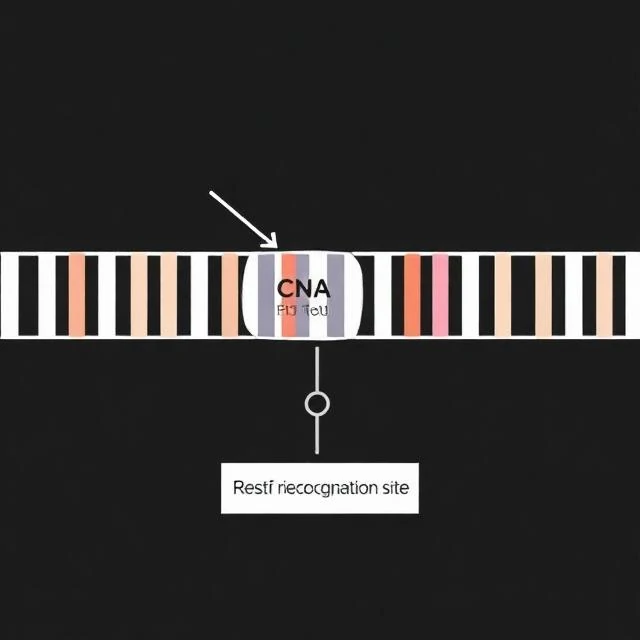
Bacteria defend themselves against viruses with enzymes that cut foreign DNA. These enzymes recognize specific short sequences and cut the DNA at or near that site. They are called restriction enzymes, and they are the scissors of molecular biology. Without them, gene cloning would be impossible.
Restriction enzymes recognize sequences of four to eight base pairs, called restriction sites. Some cut straight across both strands, producing blunt ends. Others cut at offset positions, producing sticky ends with short single-stranded overhangs. Sticky ends are useful because they can anneal with complementary overhangs on another DNA fragment, allowing ligase to join them. The enzyme EcoRI, for example, recognizes the sequence GAATTC and cuts between G and A, producing a four-base overhang.
Restriction enzymes are used in many techniques. They cut DNA for cloning, mapping, and analysis. They fragment DNA for sequencing. They detect mutations by cutting at or near a variant site. They are also used in DNA fingerprinting, where the pattern of fragments varies between individuals.
Hundreds of restriction enzymes are commercially available, each with its own recognition site and cutting pattern. They are named after the organism they came from: EcoRI from E. coli, HindIII from Haemophilus influenzae, BamHI from Bacillus amyloliquefaciens. The naming convention is a small reminder of the microbial origins of these essential tools.
Comments
No comments yet. Be the first to share a thought.
Leave a comment