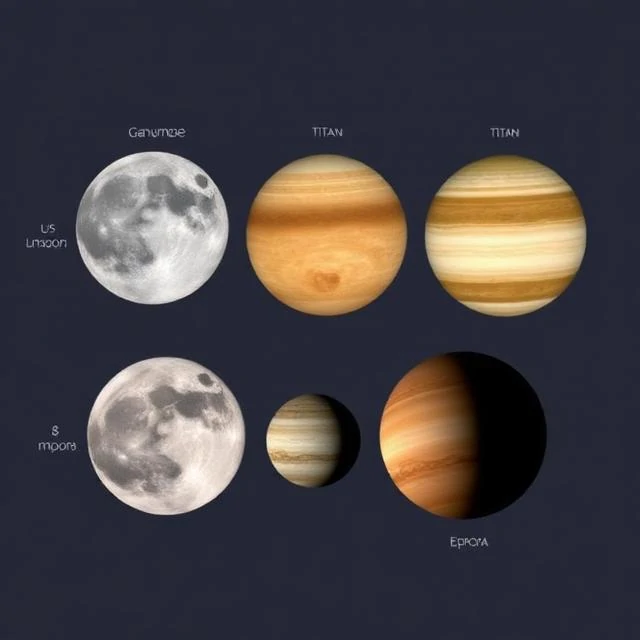
A moon is a natural satellite that orbits a planet or a smaller body. Earth has one, but the solar system has hundreds. Jupiter alone has over 90 confirmed moons. Saturn has more than 140. Some are large and round, like Earth's Moon and Jupiter's Ganymede. Others are small, irregular, and probably captured asteroids.
Moons form in different ways. Earth's Moon likely formed from debris after a Mars-sized body struck Earth early in its history. The large moons of Jupiter and Saturn probably formed from the same disk of gas and dust that formed the planets. Captured moons, like Neptune's Triton, were once independent objects that strayed too close.
Moons are scientifically valuable. Europa and Enceladus have subsurface oceans that may harbor life. Titan has lakes of liquid methane and a thick atmosphere. Io is the most volcanically active body in the solar system. Ganymede has its own magnetic field. Each moon is a world in its own right.
The Moon also shapes Earth. Its gravity drives the tides, stabilizes Earth's axial tilt, and has been a target of exploration for over six decades. Twelve humans have walked on its surface. More are coming.
Comments
No comments yet. Be the first to share a thought.
Leave a comment