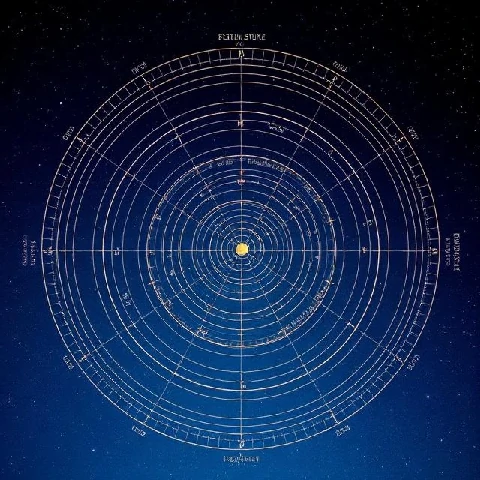
The celestial sphere is an imaginary sphere that surrounds Earth. Astronomers project stars, planets, and galaxies onto its inner surface to describe their positions. It is a convenient fiction. The stars are not actually fixed to a sphere. They are at wildly different distances. But for mapping the sky, the model works.
The sphere has coordinates. Declination is the celestial equivalent of latitude, measured in degrees north or south of the celestial equator. Right ascension is the equivalent of longitude, measured in hours, minutes, and seconds eastward from the vernal equinox. Together they give every object a unique address on the sky.
The sphere also has reference points. The celestial poles are directly above Earth's poles. The celestial equator is the projection of Earth's equator. The ecliptic is the path the Sun appears to trace over a year, which is also the plane of Earth's orbit. The zodiac constellations lie along the ecliptic.
The celestial sphere is a map, not a physical object. It is a tool that has served astronomers for millennia and still organizes how we describe the sky.
Comments
No comments yet. Be the first to share a thought.
Leave a comment