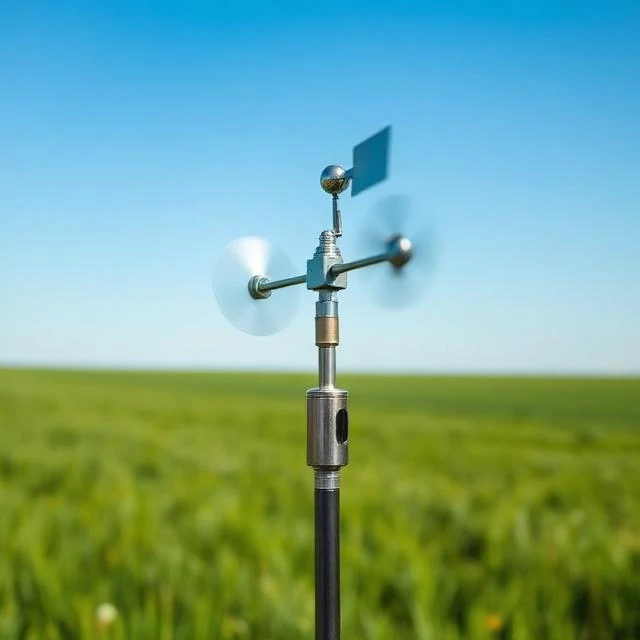
An anemometer is an instrument used to measure wind speed, and often wind direction, in agriculture and meteorology. The most common type, the cup anemometer, was invented in 1846 by Irish astronomer John Thomas Romney Robinson; it consists of three or four hemispherical cups mounted on horizontal arms that rotate around a vertical axis, with rotation speed proportional to wind velocity. Other designs include the vane anemometer, hot-wire anemometer, sonic anemometer, and laser Doppler anemometer. In agriculture, anemometers inform irrigation scheduling, pesticide spraying decisions, greenhouse ventilation, wind erosion risk, and the siting of windbreaks and wind turbines. Handheld models are common for field scouting, while fixed masts log continuous data for research stations and precision-farming networks. Modern sonic anemometers measure three-dimensional wind components and are used in eddy-covariance studies of crop carbon and water fluxes. Accurate wind data help farmers avoid spray drift, protect sensitive crops, and optimise microclimate management in orchards and vineyards.
Comments (3)
Karen Liu
We installed one on our roof last year just out of curiosity. The wind speeds during storms were way higher than I expected.
Doug H.
The cup anemometer is the classic design but ultrasonic ones are becoming more common because they have no moving parts.
Tina Marsh
Is an anemometer the same thing as a wind vane? I always mix those two up.
Comments (3)
Leave a comment