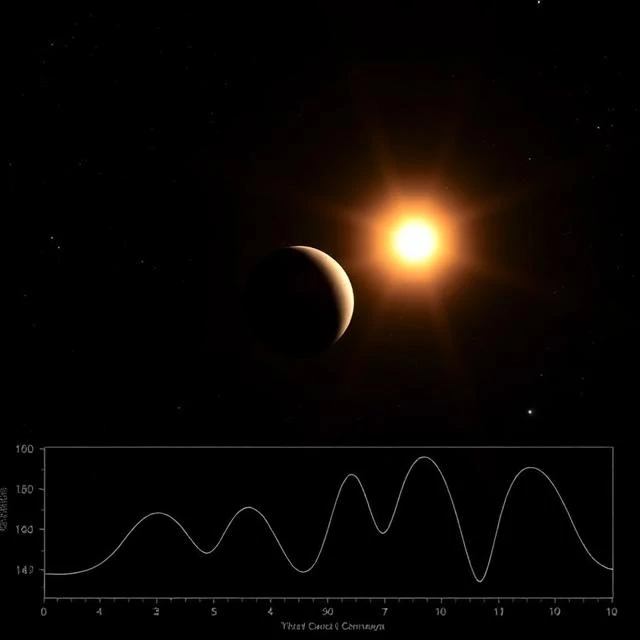
When a planet passes in front of its star, it blocks a tiny fraction of the star's light. That dip in brightness is the transit method of detecting exoplanets. It is the most productive technique in exoplanet science, responsible for thousands of discoveries. The Kepler mission alone found over 2,600 planets using this method.
The transit is small. A Jupiter-sized planet transiting a Sun-sized star dims it by about 1 percent. An Earth-sized planet dims it by 0.01 percent, which is like detecting a fly crossing a car headlight. Measuring such tiny dips requires extremely precise photometry. Space telescopes are ideal because they avoid the atmosphere's blurring and brightening effects.
The transit method reveals more than the planet's existence. The depth of the dip tells us the planet's size relative to its star. The time between transits tells us its orbital period. If we know the star's size, we know the planet's size. If we also measure the star's radial velocity wobble, we know the planet's mass. Size and mass together give density, which hints at whether the planet is rocky, gaseous, or watery.
Transits also let us study atmospheres. When starlight passes through a planet's atmosphere during transit, some wavelengths are absorbed. By comparing the spectrum during transit to the spectrum outside it, astronomers can detect molecules like water, methane, and carbon dioxide. The James Webb Space Telescope is doing this now.
Comments
No comments yet. Be the first to share a thought.
Leave a comment