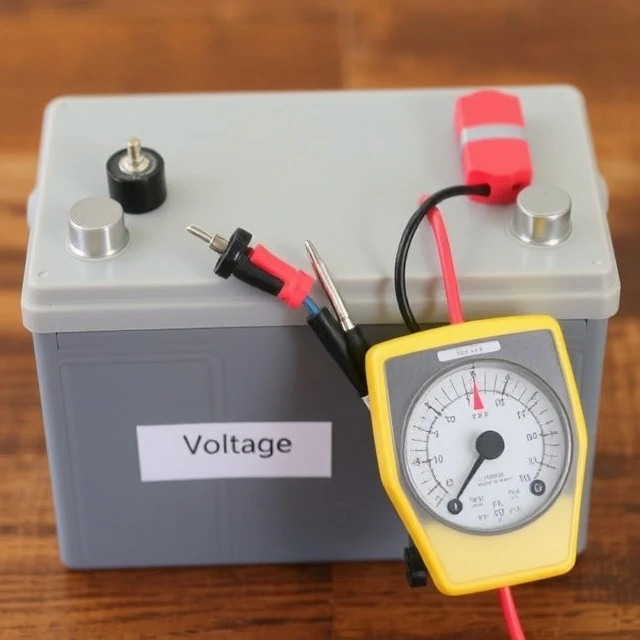
Voltage is the electric potential difference between two points. It is the push that drives electric current through a circuit. It is measured in volts. A 1.5-volt battery has a potential difference of 1.5 volts between its terminals. A 120-volt outlet has a potential difference of 120 volts. Voltage is not the same as current. Current is the flow of charge. Voltage is the force that drives that flow. Without voltage, current does not flow. Voltage is often described as electrical pressure, though the analogy is imperfect.
Voltage is created by separating electric charge. A battery uses chemical reactions to move electrons from one terminal to another. A generator uses electromagnetic induction to create a potential difference. A solar cell uses the photoelectric effect. Voltage can be measured with a voltmeter, which is connected in parallel with the component being measured. Voltage is a scalar quantity, but it has a sign. The sign indicates which point is at a higher potential. Voltage is essential to every electrical device. It determines how much current flows for a given resistance, following Ohm's law. It also determines how much energy each unit of charge carries.
Voltage facts
- Definition. Electric potential difference.
- Unit. Volt (V).
- Ohm's law. V = IR.
- Sources. Batteries, generators, solar cells.
- Measurement. Voltmeter, connected in parallel.
Voltage is not the same as current. Voltage is the push. Current is the flow.
Comments
No comments yet. Be the first to share a thought.
Leave a comment