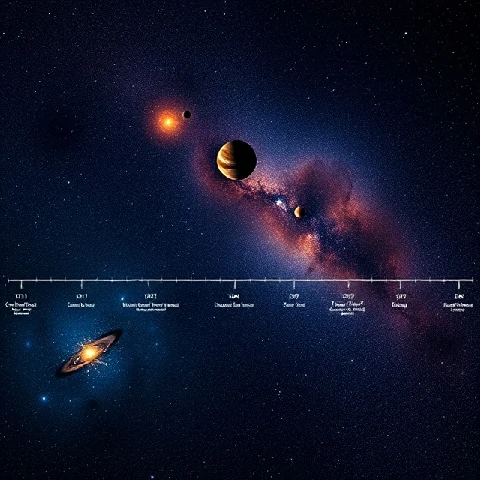
Cosmology is the study of the universe as a whole. It asks how the universe began, how it evolved, and what it is made of. It is one of the oldest inquiries in human history, and one of the most active areas of modern physics. The big bang theory is the central framework. It holds that the universe began about 13.8 billion years ago in a hot, dense state, and has been expanding and cooling ever since. The cosmic microwave background, discovered in 1964, is the leftover radiation from that early epoch. It is the oldest light in the universe.
Cosmology has advanced rapidly in recent decades. Observations of distant supernovae revealed that the expansion of the universe is accelerating, driven by a mysterious entity called dark energy. Dark matter, which does not emit or absorb light, makes up about 27 percent of the universe. Ordinary matter, the stuff of stars, planets, and people, is only about 5 percent. The rest is dark energy. The standard model of cosmology, called Lambda-CDM, describes the universe as flat, expanding, and dominated by dark energy and cold dark matter. It fits the data remarkably well, but the nature of dark matter and dark energy remains unknown.
Cosmology topics
- Big bang. Origin of the universe.
- Cosmic microwave background. Radiation from the early universe.
- Dark matter. Invisible mass that shapes galaxies.
- Dark energy. Drives accelerating expansion.
- Inflation. Rapid expansion in the first fraction of a second.
Cosmology is not just about the past. It is about the future, too. The universe will continue to expand, and the fate of everything depends on dark energy.
Comments
No comments yet. Be the first to share a thought.
Leave a comment