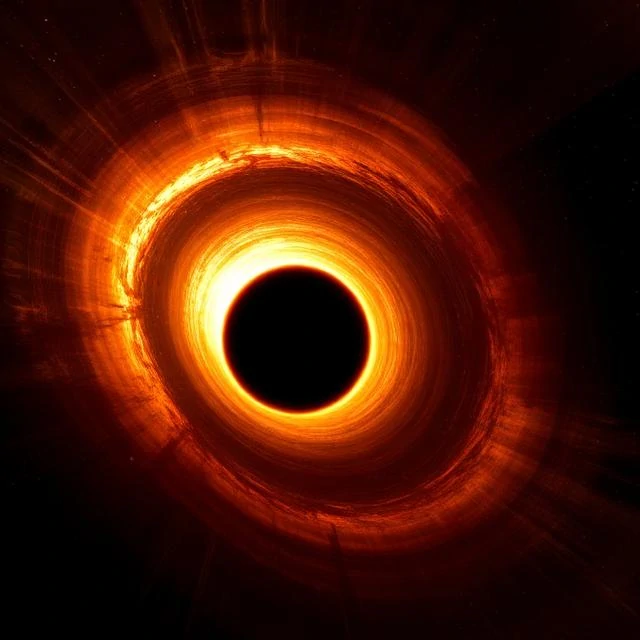
A black hole is a region of spacetime where gravity is so strong that nothing can escape, not even light. The boundary is called the event horizon. Cross it, and there is no way back. The term was coined in the 1960s, but the idea goes back to the 18th century, when John Michell and Pierre-Simon Laplace independently proposed objects so massive that light could not escape them.
Black holes form when massive stars collapse at the end of their lives. The core implodes, and if it is heavy enough, no known force can stop the collapse. The result is a singularity, a point of infinite density, surrounded by an event horizon. Stellar-mass black holes are a few times the mass of the Sun. Supermassive black holes, millions to billions of solar masses, sit at the centers of most galaxies, including ours.
They are not entirely black. Matter falling in forms an accretion disk that radiates brightly. In 2019, the Event Horizon Telescope captured the first image of a black hole's shadow in the galaxy M87. In 2015, LIGO detected gravitational waves from two black holes merging, confirming a prediction of general relativity a century old.
Comments
No comments yet. Be the first to share a thought.
Leave a comment