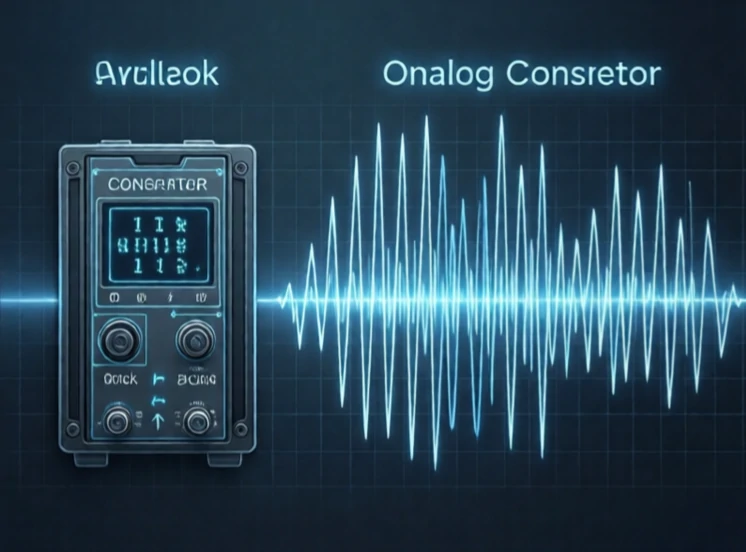
Your phone stores music as numbers. Your ears need pressure waves. Between them sits a digital-to-analog converter. It takes a stream of digital values and produces a continuous analog signal. The result is sound, or an image, or any other physical quantity. DACs are the reverse of ADCs.
DACs are everywhere. They are in phones, computers, televisions, and car stereos. They convert digital audio to analog for speakers and headphones. They convert digital video to analog for older displays. They convert digital control signals to analog voltages for motors and actuators.
Key specs
- Resolution: bits per sample, like 16, 24, 32
- Sample rate: samples per second, in Hz
- Accuracy: how closely it matches the intended signal
- Speed: how fast it can convert
DAC quality matters for audio. A cheap DAC adds noise and distortion. A good one reproduces the original faithfully. Audiophiles buy external DACs for better sound. But for most people, the DAC in their phone is good enough. The digital world becomes real at the DAC.
Comments
No comments yet. Be the first to share a thought.
Leave a comment