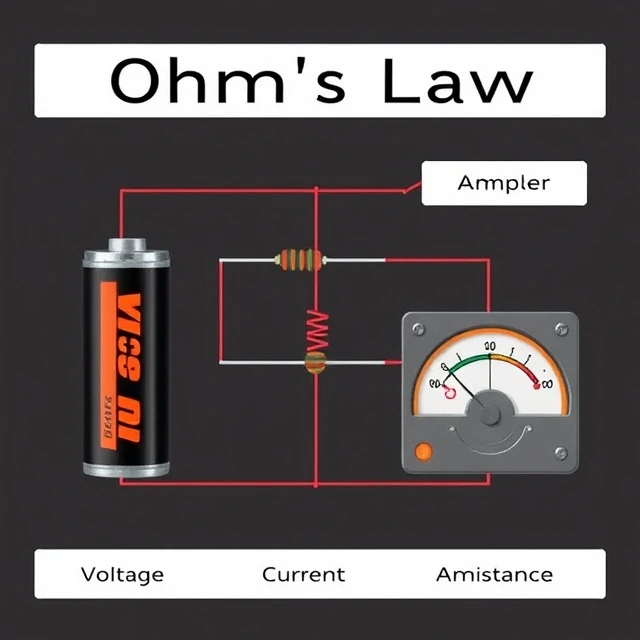
Georg Ohm published his law in 1827, and it became one of the most useful relationships in electronics. Ohm's law says that voltage equals current times resistance, or V = IR. It relates the three fundamental quantities of a circuit. Voltage is the electrical push. Current is the flow of charge. Resistance is the opposition to that flow. If you know two of the three, you can calculate the third. The law works for many materials and components, though not all. Materials that obey it are called ohmic. Materials that do not are called non-ohmic.
Ohm's law is used every day by engineers and electricians. It helps design circuits, choose resistors, and troubleshoot problems. A 12-volt battery connected to a 6-ohm resistor produces 2 amps of current. A 120-volt outlet connected to a 60-watt bulb draws 0.5 amps. The law also explains why high-voltage transmission lines are efficient. Higher voltage means lower current for the same power, and lower current means less energy lost to resistance in the wires. Ohm's law is not a fundamental law of nature. It is an empirical relationship that holds for many materials under many conditions.
Ohm's law facts
- Equation. V = IR.
- Voltage. Electrical push, measured in volts.
- Current. Flow of charge, measured in amps.
- Resistance. Opposition to flow, measured in ohms.
- Ohmic materials. Obey the law. Non-ohmic do not.
Ohm's law is not the same as Kirchhoff's laws. Ohm's law relates voltage, current, and resistance. Kirchhoff's laws relate currents and voltages in circuits.
Comments
No comments yet. Be the first to share a thought.
Leave a comment