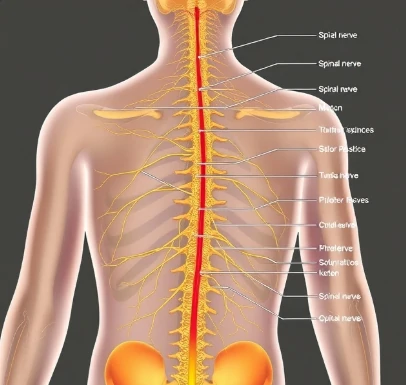
The peripheral nervous system consists of all the neural structures outside the brain and spinal cord. It links the central nervous system to the limbs, organs, and sensory receptors.
Sensory (afferent) divisions carry information inward from receptors in the skin, muscles, joints, and internal organs. Motor (efferent) divisions carry commands outward to muscles and glands. The somatic system controls voluntary skeletal muscles; the autonomic system regulates involuntary functions and itself divides into sympathetic and parasympathetic branches. Cranial and spinal nerves form the major pathways of the peripheral system.
Unlike the central nervous system, peripheral nerves have a greater capacity for regeneration after injury, although recovery is often incomplete. Diseases such as peripheral neuropathy, Guillain-Barré syndrome, and various nerve compressions illustrate the vulnerability of these pathways. The peripheral nervous system is the body’s extended wiring, without which the brain would be isolated from the world and from the body it inhabits.
Every sensation that reaches the brain and every command that reaches a muscle travels through the peripheral nervous system.
Comments
No comments yet. Be the first to share a thought.
Leave a comment