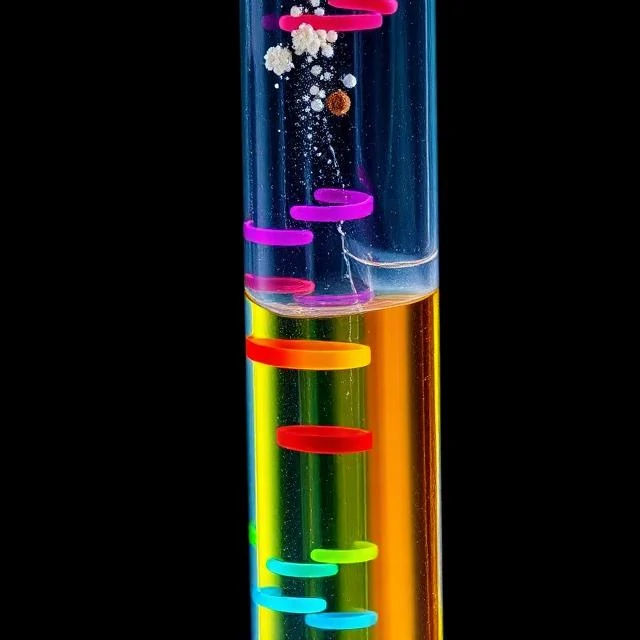
A mixture of proteins flows through a column packed with beads. Some proteins stick to the beads. Others flow through. By changing the conditions, the stuck proteins are released one by one. That is chromatography, a technique for separating and purifying biological molecules. It is the backbone of downstream processing in biomanufacturing.
The principle is simple. Molecules have different affinities for a stationary phase (the beads) and a mobile phase (the liquid flowing through). Those differences cause them to move at different speeds, separating them. The technique comes in several forms. Ion exchange chromatography separates molecules by charge. Size exclusion chromatography separates by size. Affinity chromatography uses a specific binding interaction, like an antibody binding to its target. Hydrophobic interaction chromatography separates by hydrophobicity.
Chromatography is used everywhere in biotech. It purifies insulin, monoclonal antibodies, and vaccines. It analyzes blood samples for drugs and metabolites. It separates DNA fragments for sequencing. It is a workhorse of analytical chemistry and process development.
The challenge is scale. A column that works in a lab may not work in a factory. The beads, the flow rate, the pressure, and the buffers must all be optimized. A single purification step can take hours and cost thousands of dollars. The purity it achieves is worth the effort.
Comments (2)
Leave a comment