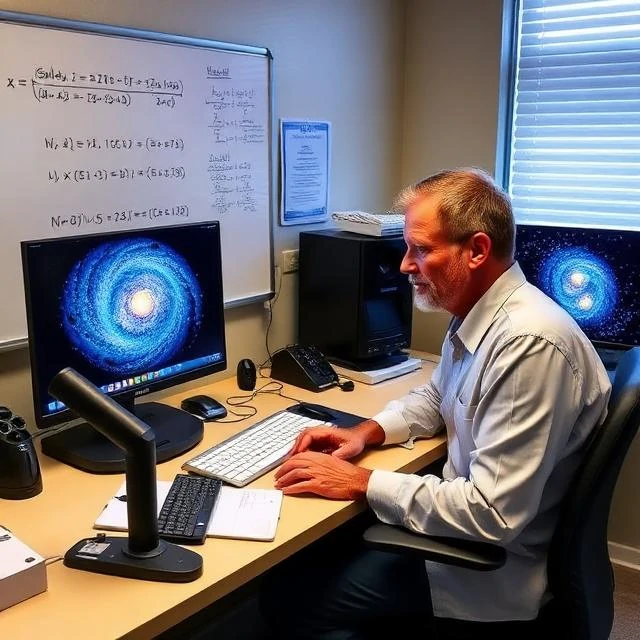
Astrophysics applies the laws of physics to celestial objects. It asks how stars shine, how galaxies form, how black holes bend light, and what the universe was like in its first seconds. The field does not simply describe what is out there. It explains why.
The toolkit is broad. Nuclear physics explains how stars fuse hydrogen into helium. Thermodynamics governs the structure of stellar interiors. Electromagnetism describes how magnetic fields accelerate particles in solar flares and pulsar winds. General relativity predicts the behavior of gravity near black holes and across the expanding universe. Quantum mechanics explains the radiation from the earliest moments after the Big Bang.
Astrophysicists work with data from telescopes on the ground and in space. They build models, run simulations, and compare predictions with observations. When the two disagree, either the model is wrong or the observation is. Both outcomes advance the field.
The work is humbling. The universe is larger, older, and stranger than anyone imagined a century ago. Astrophysics is how we try to make sense of it.
Comments (2)
Leave a comment