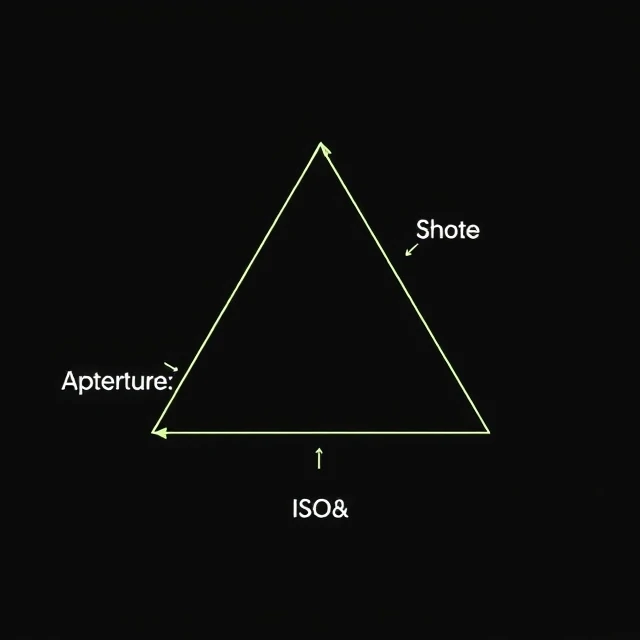
The exposure triangle is a model that shows how aperture, shutter speed, and ISO work together to determine exposure. Change one and you must change another to keep the brightness the same. Each has a side effect. Aperture affects depth of field. Shutter speed affects motion blur. ISO affects noise. The triangle is not a law of physics. It is a teaching tool, and a useful one. It helps photographers understand the trade-offs involved in every exposure decision.
The three variables are measured in stops. A stop is a doubling or halving of light. Aperture stops are f/1.4, f/2, f/2.8, f/4, and so on. Shutter speed stops are 1/1000, 1/500, 1/250, and so on. ISO stops are 100, 200, 400, 800, and so on. Moving one stop in any direction changes the exposure by a factor of two. The triangle lets you balance these changes. If you need a faster shutter speed to freeze motion, you can open the aperture or raise the ISO to compensate. If you need more depth of field, you can stop down the aperture and slow the shutter or raise the ISO.
Trade-offs in the triangle
- Aperture. Wider apertures blur the background.
- Shutter speed. Slower speeds blur motion.
- ISO. Higher ISO adds noise.
The exposure triangle is not a rule. It is a map. Once you know the territory, you can ignore the map and shoot by feel.
Comments
No comments yet. Be the first to share a thought.
Leave a comment