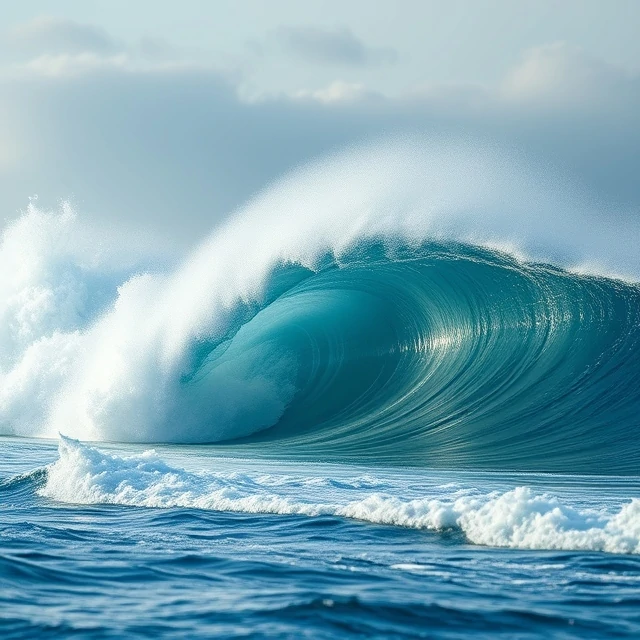
Some waves are not driven by wind. A tsunami is a series of ocean waves with extremely long wavelength, usually caused by underwater earthquakes, landslides, or volcanic eruptions, that can travel across entire ocean basins and rise dramatically near shore.
In deep water a tsunami may pass under a ship almost unnoticed. In shallow coastal water it can become a fast-moving wall of water that inundates low-lying areas. Warning systems use seismic data and sea-level gauges to issue alerts. Evacuation to high ground is the primary life-saving response ashore.
Ships in harbor may try to put to sea if warning time allows, because deep water is safer than a confined port. Tsunami risk is highest in the Pacific and other geologically active regions. Coastal design and public education reduce casualties when the waves arrive.
- Long-wavelength wave caused by major seafloor disturbance
- Travels fast in deep water; rises near shore
- Detected by seismic and sea-level networks
- Requires rapid evacuation of low-lying coasts
Comments
No comments yet. Be the first to share a thought.
Leave a comment