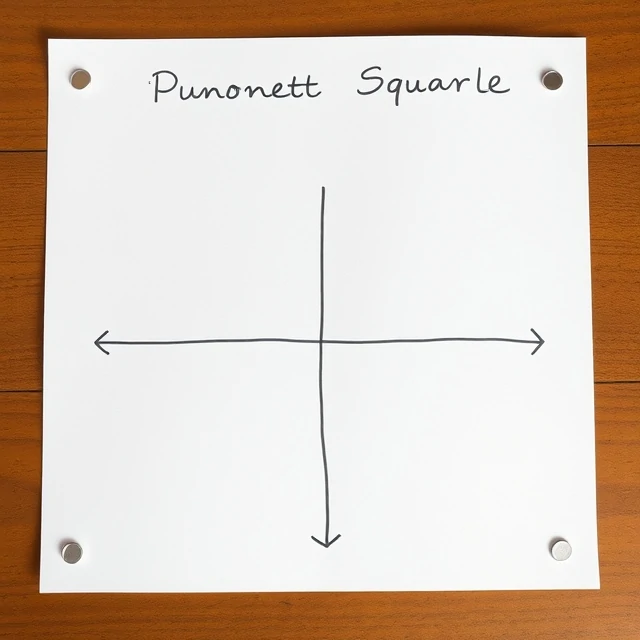
Predicting the genetic makeup of offspring once required lengthy trial and error. The Punnett square turns the problem into a simple grid. One parent’s alleles are written across the top, the other parent’s down the side; each box then shows a possible genotype for the child.
For a single gene with two alleles the square has four cells and immediately reveals the classic 3:1 or 1:2:1 ratios. Dihybrid crosses expand to sixteen cells and illustrate independent assortment. The tool works for dominant, recessive, and codominant traits alike.
Students and genetic counselors still use Punnett squares to explain inheritance risks. The diagram makes abstract probabilities concrete and shows why carrier parents can have both affected and unaffected children. It remains one of the most effective teaching devices in genetics.
- Grid for predicting offspring genotypes
- Places parental alleles on axes
- Reveals Mendelian ratios at a glance
- Useful for single-gene and dihybrid crosses
Comments
No comments yet. Be the first to share a thought.
Leave a comment