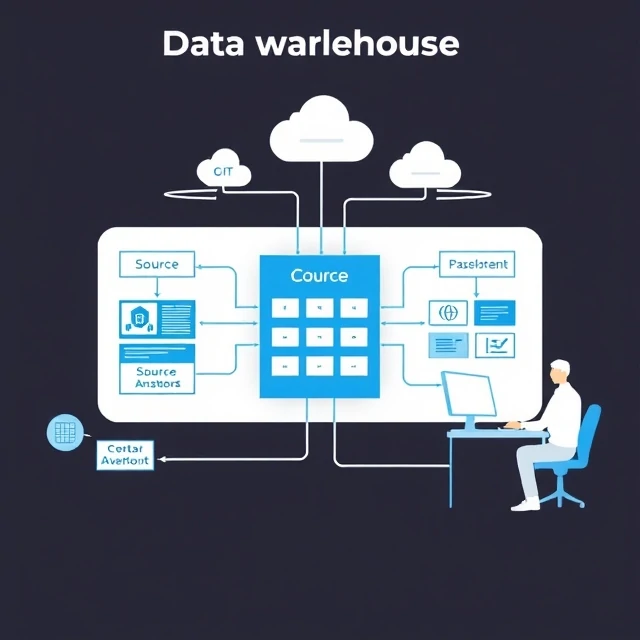
A data warehouse stores integrated data from multiple sources for analysis. It is not a production database. Production systems run the business. The warehouse supports reporting and decision-making. Data flows from source systems into the warehouse through ETL or ELT pipelines. The warehouse cleans, transforms, and organizes the data into a schema optimized for queries. Analysts and business intelligence tools query the warehouse instead of the production systems.
The architecture separates workloads. Running a heavy analytical query on a production database slows down the applications that customers use. The warehouse isolates that load. It also integrates data. A customer's orders, support tickets, and web activity live in different systems. The warehouse brings them together. That unified view is where insight comes from. Traditional warehouses ran on specialized appliances from Teradata, Oracle, and IBM. Cloud warehouses like Snowflake, BigQuery, and Redshift changed the economics. They separate storage from compute, scale elastically, and charge by usage. The barrier to entry dropped. Smaller companies can now afford warehouse capabilities that once required a large capital investment. The technology changed. The purpose did not: store integrated data for analysis.
Warehouse characteristics
- Subject-oriented — organized around business domains
- Integrated — combines data from multiple sources
- Time-variant — keeps historical data
- Non-volatile — data is loaded and read, not updated in place
- Optimized for queries — indexes, partitions, columnar storage
A warehouse is a library. Source systems are the authors. Analysts are the readers. The warehouse organizes the collection.
Comments
No comments yet. Be the first to share a thought.
Leave a comment