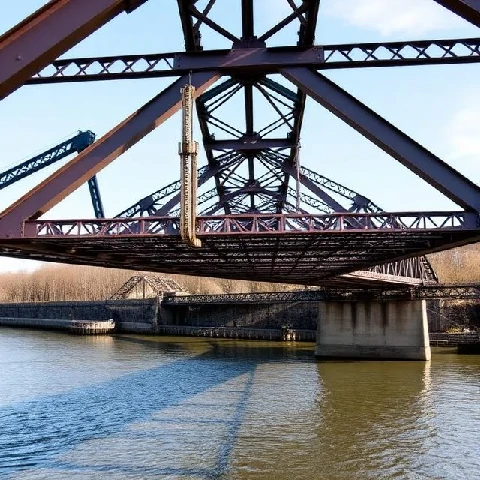
A truss is a framework of triangles used to span large distances. The triangle is the key. It is the only polygon that cannot change shape without bending its sides. Arrange triangles in a row or a web, and you get a structure that is strong, stiff, and light. Trusses are used in roofs, bridges, and floors. A roof truss spans from wall to wall and supports the roof. A bridge truss carries traffic across a river. A floor truss supports a floor above an open space. Trusses can be made of timber, steel, or a combination.
The members of a truss carry either tension or compression. Top chords are usually in compression. Bottom chords are usually in tension. Diagonals and verticals transfer forces between them. The joints, called nodes, are where the members meet. In a pin-jointed truss, the members are assumed to rotate freely at the nodes, which simplifies the analysis. The truss is efficient because it places material where it is needed and removes it where it is not. A truss can span a distance that would require a much heavier solid beam.
Trusses come in several types. A king post truss has a single vertical post. A queen post truss has two. A Howe truss has diagonals in compression. A Pratt truss has diagonals in tension. A Warren truss has alternating diagonals. A scissors truss has angled chords for a vaulted ceiling. Each has its own geometry and its own application. The truss is a classic structural form. It is also a modern one. It is used in houses, warehouses, and bridges. It is everywhere. It is efficient. It is elegant. It is a triangle.
Comments
No comments yet. Be the first to share a thought.
Leave a comment