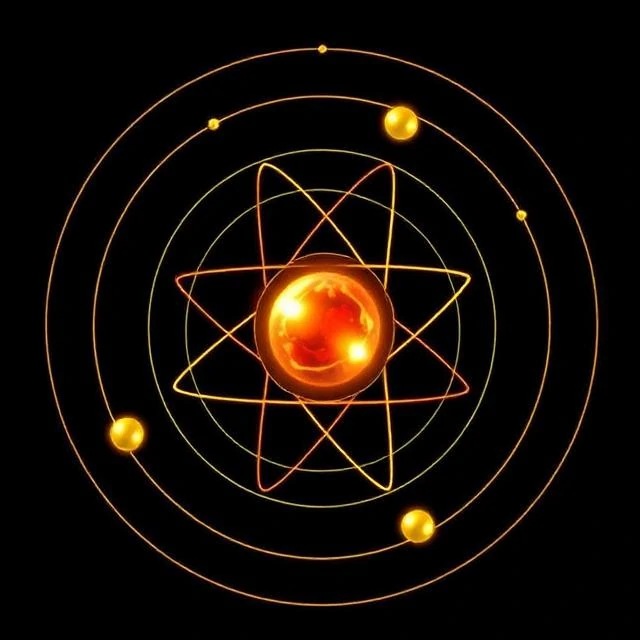
J.J. Thomson discovered the electron in 1897 by studying cathode rays. He showed that the rays were streams of negatively charged particles much smaller than atoms. The electron was the first subatomic particle discovered. It carries a negative charge of 1.602 times 10 to the minus 19 coulombs and has a mass of about 9.11 times 10 to the minus 31 kilograms, about 1/1836 the mass of a proton.
Electrons occupy orbitals around the nucleus. In the quantum mechanical model, an orbital is a region of space where the electron is likely to be found. The shapes of orbitals are described by s, p, d, and f. Each orbital holds a maximum of two electrons with opposite spins. The arrangement of electrons in an atom is called its electron configuration. The outermost electrons, called valence electrons, determine chemical behavior.
Electrons are involved in chemical bonding, electricity, and magnetism. They flow through wires as electric current. They absorb and emit light when they jump between energy levels, which is the basis of spectroscopy. They are fundamental to the periodic table, which organizes elements by their electron configurations.
Electrons are not just particles. They exhibit wave-particle duality. They can diffract like waves and collide like particles. The double-slit experiment demonstrates this. The electron is a quantum object, and its behavior defies classical intuition.
Comments
No comments yet. Be the first to share a thought.
Leave a comment