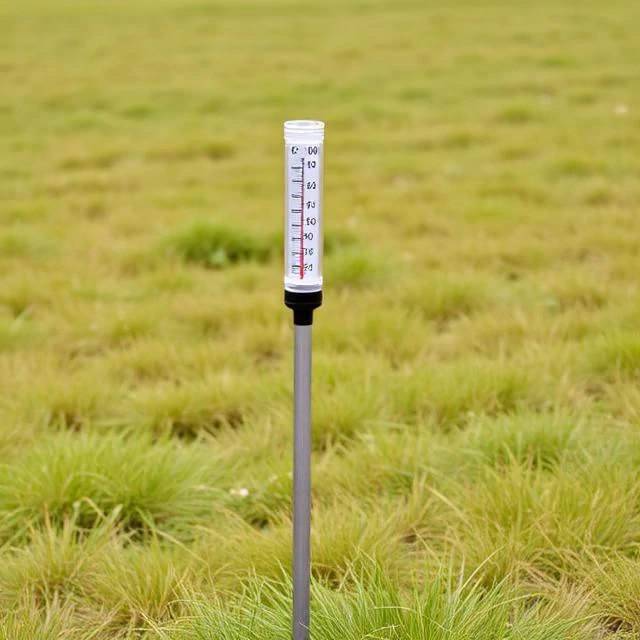
A rain gauge measures how much rain falls in a given place over a given time. The simplest design is a straight-sided cylinder with a funnel on top and a measuring stick inside. More precise versions use a tipping bucket that clicks each time it catches a small amount, or a weighing gauge that records the mass of water collected.
Farmers have kept rain records for centuries, and the data still matters. Rainfall totals guide planting dates, irrigation scheduling, and pesticide application. Too much rain at harvest can ruin a crop. Too little at flowering can cut yield. Knowing what actually fell, not what the forecast promised, is the only way to make good decisions.
Types in use
- Standard cylinder gauge: cheap and reliable
- Tipping bucket: automatic, logs to a data recorder
- Weighing gauge: accurate for snow and rain
- Disdrometer: measures drop size and intensity
Placement matters. A gauge under a tree or too close to a building reads low. Weather services recommend open ground, away from obstacles, with the rim level and about 30 centimetres above the surface.
Comments
No comments yet. Be the first to share a thought.
Leave a comment