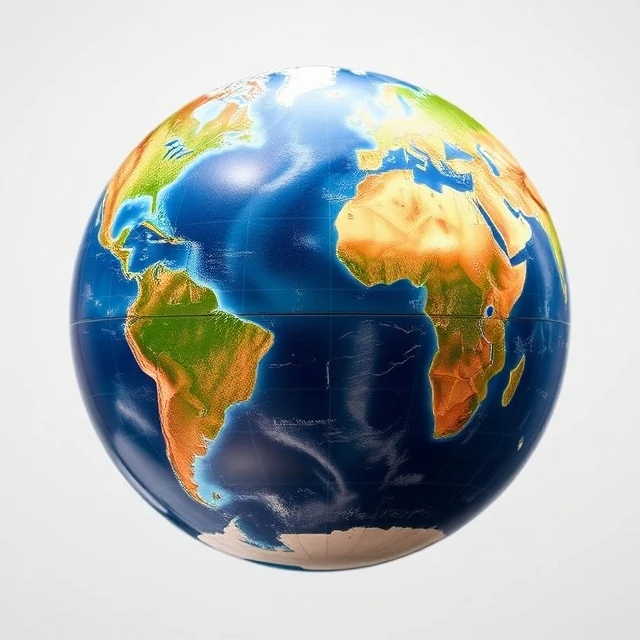
Earth can be sliced into halves in more than one way. A hemisphere is any half of the planet bounded by a great circle. The equator divides Northern and Southern Hemispheres; the prime meridian and 180th meridian divide Eastern and Western Hemispheres.
Climate patterns, seasonal timing, and even cultural histories differ markedly between the Northern and Southern Hemispheres because of the unequal distribution of land and ocean. Most of the world’s land and population lie in the Northern Hemisphere.
The term also appears in less formal contexts, such as the land and water hemispheres centered on particular points. In everyday geography, the Northern–Southern and Eastern–Western divisions remain the most widely used. Each hemisphere offers a different perspective on global patterns.
- Half of Earth defined by a great circle
- Northern/Southern divided by the equator
- Eastern/Western divided by the prime meridian
- Differ in land distribution and climate patterns
Comments (2)
Leave a comment