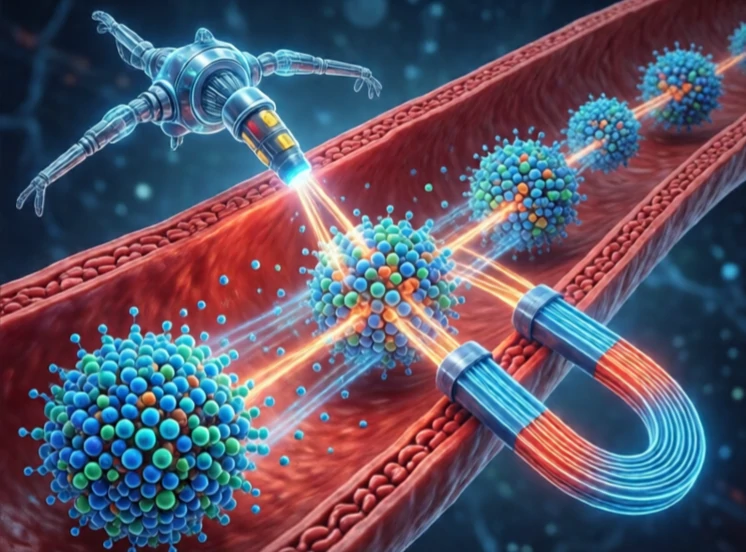
A nanorobot operates at the nanoscale, measured in billionths of a meter. It is smaller than a virus, smaller than a wavelength of visible light. At this scale, robots are not miniature machines with gears and motors. They are molecules or molecular assemblies designed to perform a function.
Nature already builds nanoscale machines. The ribosome is a molecular assembler. ATP synthase is a rotary motor. Kinesin walks along microtubules. Scientists copy these designs. DNA origami folds DNA strands into shapes. Molecular motors convert chemical energy into motion. Some nanorobots are tiny particles that respond to magnetic fields or light.
Nanorobot approaches
- DNA-based: self-assembling structures for drug delivery.
- Molecular motors: synthetic or biological, powered by ATP.
- Magnetic nanoparticles: steered by external fields.
- Light-driven: activated by specific wavelengths.
- Hybrid: combining biological and synthetic components.
Nanorobots are mostly research. Medical applications are the long-term goal: a robot that swims through the bloodstream, identifies a cancer cell, and releases a drug only there. That would eliminate the side effects of chemotherapy. Other applications include environmental cleanup, molecular manufacturing, and computing at the molecular level. The challenges are enormous. How do you power a nanorobot? How do you control it? How do you communicate with it? How do you build billions of them? None of these are solved. The field is early, but the promise is large. A machine the size of a molecule that can repair cells or build materials is a powerful idea, and it is slowly becoming real.
Comments
No comments yet. Be the first to share a thought.
Leave a comment