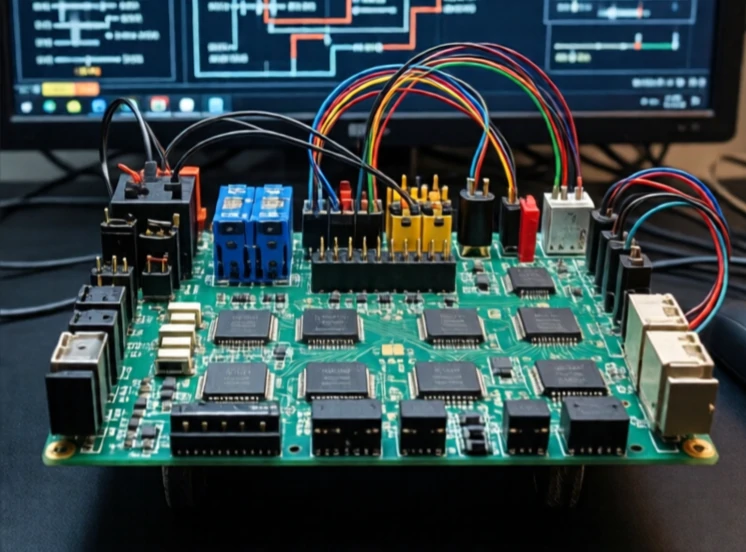
A microcontroller is a compact integrated circuit that controls embedded systems. It contains a processor, memory, and input/output peripherals on a single chip. Unlike a general-purpose computer, a microcontroller runs one program, often forever, with tight timing and low power.
The first microcontroller, the Intel 4004, arrived in 1971. It had 2,300 transistors. Today's microcontrollers pack millions of transistors and cost less than a dollar. They are in toys, appliances, cars, and robots. A robot might use one microcontroller for motor control, another for sensor reading, and a third for communication. They talk to each other over serial buses.
Microcontroller components
- CPU: executes instructions.
- Flash memory: stores the program.
- RAM: stores temporary data.
- GPIO: pins for digital input and output.
- Peripherals: timers, ADCs, UART, SPI, I2C.
Choosing a microcontroller means balancing speed, memory, power, and cost. An 8-bit ATmega is fine for a simple line follower. A 32-bit ARM Cortex-M4 with floating-point math is better for a drone flight controller. Real-time performance matters more than raw clock speed. The microcontroller must respond to sensor inputs within microseconds. That is why many robots use interrupts and direct memory access instead of polling loops. The microcontroller is the quiet workhorse of robotics. It does not run an operating system. It runs the code that makes the robot move.
Comments
No comments yet. Be the first to share a thought.
Leave a comment