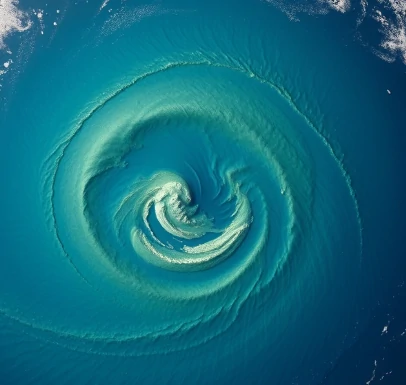
Ocean currents rarely flow in straight lines. They meander and frequently pinch off rotating parcels of water known as eddies. These features range from a few kilometers to hundreds of kilometers across and can persist for months, carrying heat, salt, nutrients, and organisms far from their origin.
Mesoscale eddies, the oceanic analogues of weather systems, dominate the kinetic energy of the ocean. They are visible in satellite sea-surface height and temperature maps as circular anomalies. Cyclonic and anticyclonic eddies have opposite effects on the thermocline and on biological productivity; some uplift nutrients and stimulate phytoplankton growth at their edges or centers.
Eddies stir the ocean, contributing to mixing and to the transport of properties across mean flow paths. They complicate the interpretation of sparse observations and must be represented or parameterized in climate models. High-resolution satellite data and autonomous floats have greatly improved the ability to track individual eddies and quantify their cumulative impact.
A single large eddy can transport more water than many of the world’s major rivers combined.
Comments
No comments yet. Be the first to share a thought.
Leave a comment