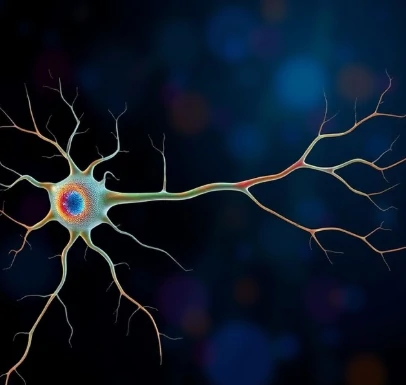
The axon is the long, slender projection of a neuron that carries electrical signals away from the cell body toward other neurons, muscles, or glands. It is the neuron’s transmission line.
Most neurons have a single axon that may branch near its end into multiple terminals. The membrane of the axon is specialized for the rapid propagation of action potentials. In many vertebrate neurons a myelin sheath—formed by glial cells—insulates the axon and allows the impulse to jump between nodes of Ranvier, greatly increasing speed. The length of axons varies enormously: some are less than a millimeter; the axons that run from the spinal cord to the toes can be more than a meter long.
At the axon terminals the electrical signal is converted into a chemical one. Neurotransmitter is released into the synaptic cleft and binds to receptors on the next cell. Damage to axons—whether by trauma, demyelinating disease, or toxic exposure—interrupts communication and can produce lasting deficits.
Every message that travels from one part of the nervous system to another travels, at some point, along an axon.
Comments (3)
Leave a comment