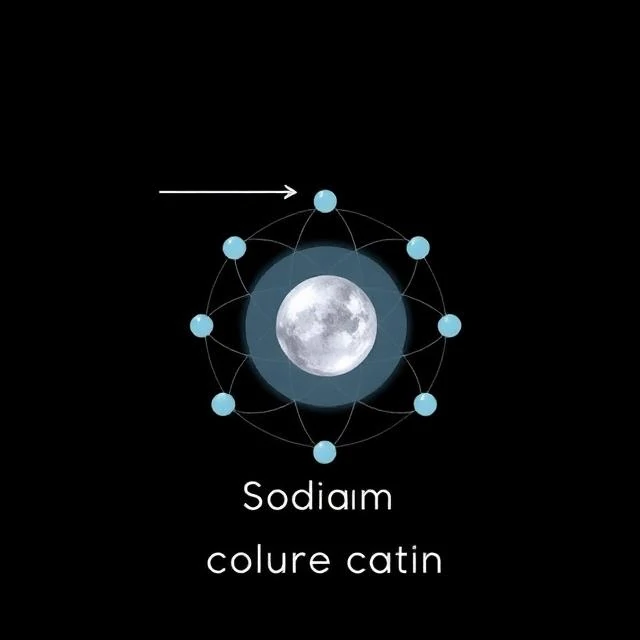
A sodium atom has 11 protons and 11 electrons. It needs to lose one electron to fill its outer shell. When it does, it becomes a sodium ion with 11 protons and 10 electrons. The extra proton gives it a net positive charge. A positively charged ion is called a cation. The name comes from the Greek word meaning going down, because cations migrate toward the cathode in electrolysis.
Cations form when atoms lose electrons. Metals tend to form cations because they have few valence electrons and lose them more easily than they gain. Sodium forms Na+, magnesium forms Mg2+, aluminum forms Al3+. The charge depends on how many electrons the atom loses to reach a stable configuration. Transition metals can form multiple cations with different charges, like iron(II) and iron(III).
Polyatomic cations are groups of atoms with a net positive charge. Ammonium (NH4+) is the most common example. It forms when ammonia accepts a proton. Other polyatomic cations include hydronium (H3O+) and mercury(I) (Hg2^2+). They behave as single units in reactions.
Cations are everywhere. Table salt is sodium cation paired with chloride anion. Fertilizers contain potassium and calcium cations. The human body uses calcium cations for muscle contraction and nerve signaling, sodium and potassium cations for nerve impulses and fluid balance, and iron cations for oxygen transport. The balance of cations and anions is essential for life.
Comments
No comments yet. Be the first to share a thought.
Leave a comment