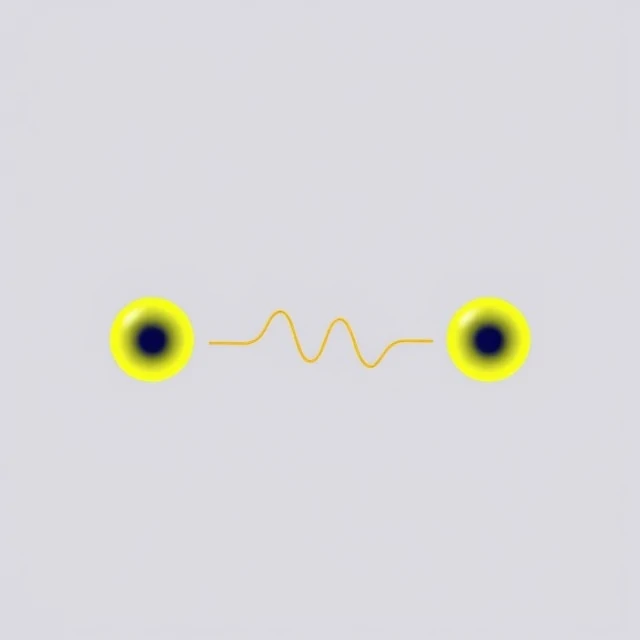
Bosons are the particles that carry forces. They are the messengers of the quantum world. When two electrons repel each other, they exchange a photon. When quarks bind together inside a proton, they exchange gluons. When a nucleus undergoes beta decay, it emits a W boson. Each fundamental force has its own boson, and together they mediate all the interactions between matter particles.
Bosons differ from fermions in a crucial way. Fermions obey the Pauli exclusion principle, which means no two can occupy the same quantum state. Bosons do the opposite. They can pile into the same state, and they prefer it. That behavior leads to remarkable effects. Lasers work because photons are bosons and can occupy the same mode. Superfluids and superconductors arise when bosons condense into a single quantum state. The Higgs boson is a special case. It is not a force carrier in the usual sense. It is the quantum of the Higgs field, which gives mass to other particles.
Boson facts
- Force carriers. Photon, gluon, W, Z, and graviton.
- Integer spin. Bosons have whole-number spin.
- Bose-Einstein condensate. A state where bosons occupy the same quantum state.
- Higgs boson. Gives mass to other particles.
The word boson honors Satyendra Nath Bose, whose work on photon statistics laid the foundation for the concept.
Comments (3)
Leave a comment