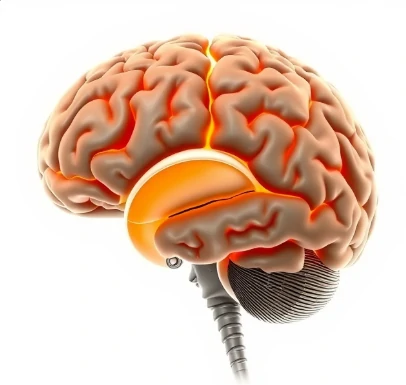
The temporal lobes lie beneath the lateral fissures on each side of the brain. Their most obvious function is auditory processing: the primary auditory cortex occupies the superior temporal gyrus and receives input from the ears via the thalamus. Damage here can produce cortical deafness or deficits in sound recognition.
The temporal lobes also house structures critical for memory. The hippocampus and surrounding medial temporal cortex are essential for forming new declarative memories. Bilateral damage produces profound anterograde amnesia while leaving remote memories and procedural skills relatively intact.
Additional regions support language comprehension (Wernicke’s area in the left hemisphere), object and face recognition, and the processing of emotional tone in speech. The temporal lobes therefore integrate sensory, mnemonic, and linguistic functions in ways that are still being mapped in detail.
- Primary auditory cortex
- Medial temporal memory system
- Language comprehension regions
- Visual object and face processing
Seizures originating in the temporal lobe can produce complex experiential phenomena, including vivid memory-like hallucinations.
Comments
No comments yet. Be the first to share a thought.
Leave a comment