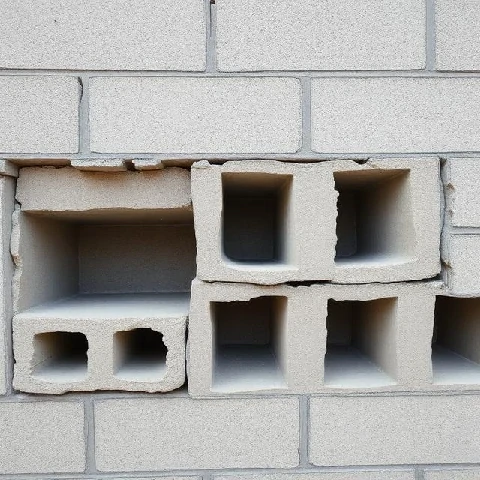
Blockwork uses large concrete or stone blocks to build walls. Concrete blocks, also called cinder blocks or CMUs, are hollow rectangular units about 8 by 8 by 16 inches. They are stacked in mortar, much like bricks, but they are much larger. That makes blockwork faster to lay than brickwork. A mason can cover more wall area in less time. The blocks are heavy, though, and the walls are thick.
Blockwork has several advantages. The hollow cores can be filled with grout and steel reinforcement to create reinforced masonry walls. That makes blockwork suitable for foundations, retaining walls, and load-bearing walls in commercial buildings. The blocks can be left exposed, painted, or faced with brick or stone. They also provide good fire resistance and thermal mass.
Blockwork has drawbacks. It is porous, so it needs waterproofing or a drainage layer below grade. It is prone to cracking if the foundation settles. It is labor-intensive compared to tilt-up or precast concrete. And the mortar joints are the weak points, especially in seismic zones. Modern blockwork often includes horizontal joint reinforcement and bond beams to improve performance. The wall is only as strong as its weakest course.
Comments
No comments yet. Be the first to share a thought.
Leave a comment