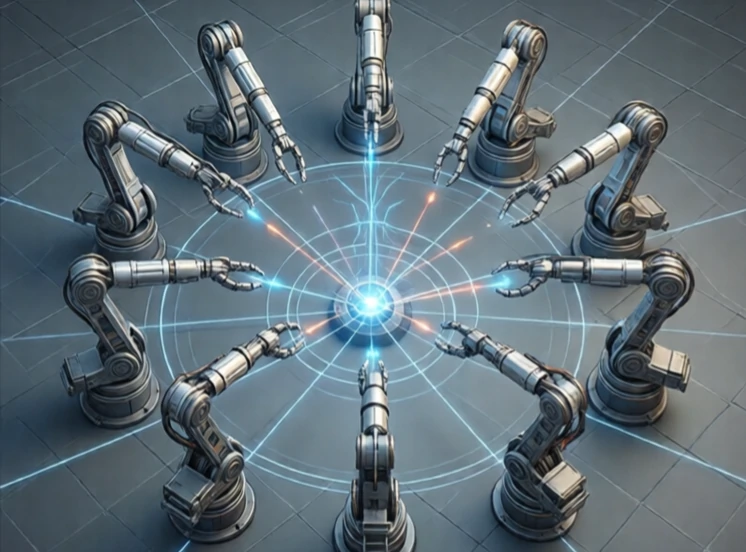
Kinematics studies motion without worrying about forces. It answers where the robot goes, not what torque it takes to get there. Forward kinematics computes the position of the end effector from the joint angles. Inverse kinematics does the opposite: given a desired position, what joint angles are needed?
Forward kinematics is straightforward. Multiply transformation matrices from base to tip. Inverse kinematics is harder. Multiple solutions may exist. Some may be out of reach. The equations can have no closed-form solution, which forces numerical methods. A six-axis robot arm typically has up to eight inverse kinematic solutions for a given pose.
Kinematic concepts
- Degrees of freedom: independent motions.
- Workspace: the volume the robot can reach.
- Singularity: a configuration where the robot loses a degree of freedom.
- Jacobian: relates joint velocities to end effector velocities.
- Redundancy: more joints than needed for a pose.
Kinematics is the first thing a robot programmer learns. It determines whether a robot can reach a point, how fast it can move there, and whether it will hit a singularity along the way. Singularities are particularly troublesome. At a singularity, the Jacobian loses rank, and small Cartesian motions require huge joint velocities. Controllers avoid them by planning paths that stay away. Kinematics is pure geometry. It ignores mass, friction, and gravity. That simplicity makes it useful as a first pass before dynamics enters the picture.
Comments
No comments yet. Be the first to share a thought.
Leave a comment