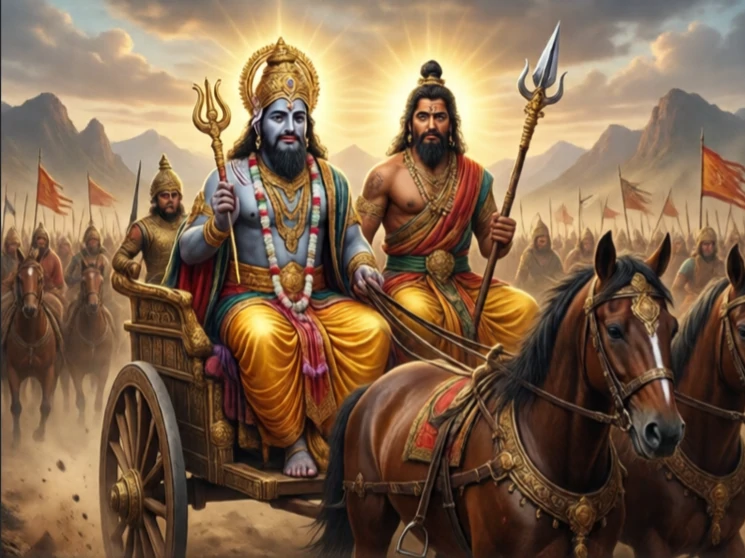
The Bhagavad Gita is a Hindu scripture in dialogue form. It is part of the Mahabharata, the great Indian epic. It consists of 700 verses. The dialogue is between Prince Arjuna and Lord Krishna. Arjuna is on a battlefield. He is about to fight a war against his own relatives. He is filled with doubt. He does not want to fight. Krishna counsels him. He teaches him about duty, devotion, and the nature of the self.
The Gita is set on the battlefield of Kurukshetra. Arjuna is a warrior. His duty is to fight. But he is paralyzed by grief. Krishna, his charioteer, reveals himself as God. He teaches Arjuna that the soul is eternal. It cannot be killed. He teaches him to do his duty without attachment to the results. He teaches him the paths of knowledge, action, and devotion. Arjuna finds clarity. He picks up his bow. He fights.
Key teachings of the Bhagavad Gita
- Duty: do your duty without attachment.
- Self: the soul is eternal, the body is temporary.
- Yoga: paths to liberation through knowledge, action, and devotion.
- God: Krishna reveals himself as the supreme Lord.
- Equanimity: remain calm in success and failure.
The Bhagavad Gita is one of the most important texts in Hinduism. It is also read by non-Hindus. It has been translated into many languages. It has inspired thinkers like Gandhi, Emerson, and Thoreau. It is a spiritual classic. It addresses universal questions. What is my duty? What is the self? How should I live? The answers are profound. They are also practical. The Gita is not just philosophy. It is a guide to life. It is a conversation between a seeker and God. It is a conversation that continues today. In every reader who opens its pages. In every soul who seeks the truth.
Comments
No comments yet. Be the first to share a thought.
Leave a comment