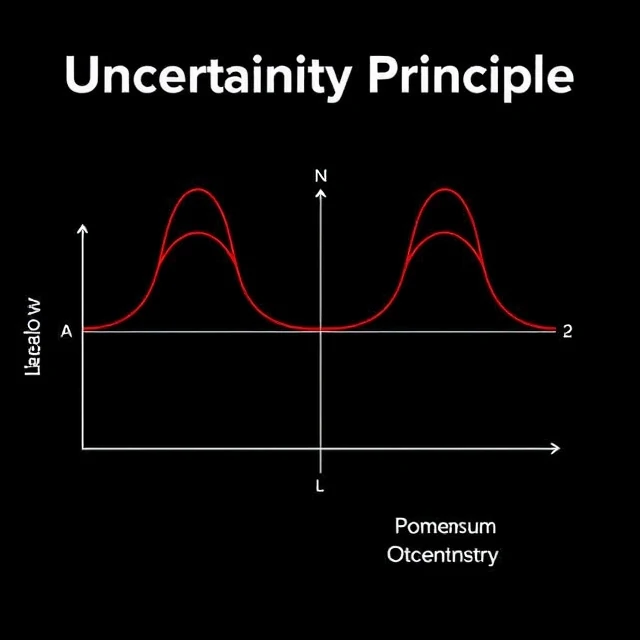
Werner Heisenberg proposed the uncertainty principle in 1927. It says that certain pairs of properties, like position and momentum, cannot both be known with arbitrary precision. The more precisely you know one, the less precisely you can know the other. The product of the uncertainties is always greater than or equal to ħ/2, where ħ is the reduced Planck constant. The principle is not about limitations of measurement tools. It is a fundamental feature of quantum mechanics. Particles do not have definite positions and momenta at the same time. They exist in a cloud of probabilities.
The uncertainty principle has profound implications. It explains why electrons do not crash into nuclei. If an electron were confined to a tiny space, its momentum uncertainty would be enormous, and it would escape. It explains why atoms have size and why matter is stable. It explains why absolute zero is unattainable. It is also the basis of quantum tunneling, where particles pass through barriers they classically could not. The uncertainty principle is not a statement about ignorance. It is a statement about the nature of reality. In the quantum world, properties are not definite until measured, and even then, some pairs cannot be simultaneously sharp.
Uncertainty principle facts
- Proposed. Werner Heisenberg, 1927.
- Pairs. Position and momentum, energy and time.
- Formula. ΔxΔp ≥ ħ/2.
- Not about tools. Fundamental feature of quantum mechanics.
- Consequences. Atomic stability, quantum tunneling.
The uncertainty principle is not the same as the observer effect. The observer effect is about measurement disturbing the system. The uncertainty principle is about the nature of quantum states.
Comments
No comments yet. Be the first to share a thought.
Leave a comment