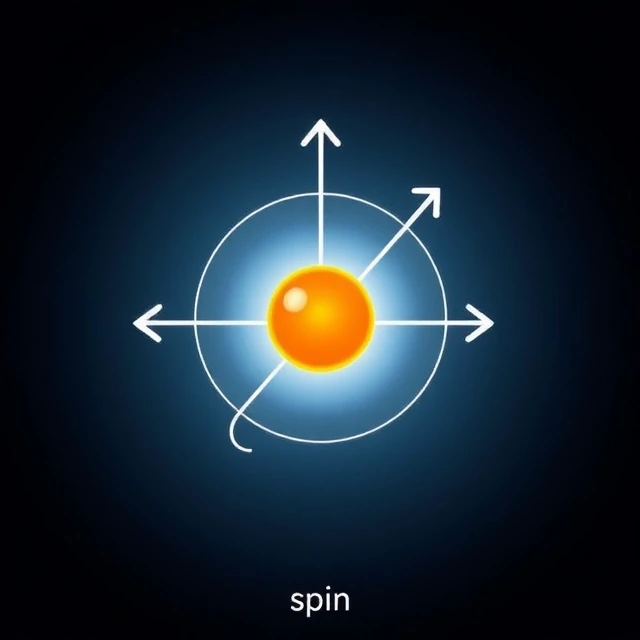
Spin is an intrinsic form of angular momentum carried by particles. It is not the same as a spinning top. A top spins around an axis. An electron has spin, but it is not spinning in space. Spin is a quantum property, like charge or mass. It comes in discrete values, measured in units of ħ, the reduced Planck constant. Electrons, protons, and neutrons have spin 1/2. Photons have spin 1. Gravitons, if they exist, have spin 2. The Higgs boson has spin 0.
Spin is a purely quantum concept. It has no classical analogue. It was discovered in the 1920s through the Stern-Gerlach experiment, which showed that silver atoms in a magnetic field split into two beams. That splitting could not be explained by orbital motion alone. Spin explains it. Spin is essential to the Pauli exclusion principle, which says no two fermions can occupy the same quantum state. That principle is why atoms have structure and why matter does not collapse. Spin is also used in magnetic resonance imaging, where hydrogen nuclei in a magnetic field absorb and emit radio waves. Spin is a fundamental property of particles, as basic as mass or charge.
Spin facts
- Definition. Intrinsic angular momentum.
- Quantum. Comes in discrete values.
- Fermions. Half-integer spin, like 1/2.
- Bosons. Integer spin, like 1 or 2.
- Discovery. Stern-Gerlach experiment, 1922.
Spin is not the same as orbital angular momentum. Orbital angular momentum comes from motion through space. Spin is intrinsic.
Comments
No comments yet. Be the first to share a thought.
Leave a comment