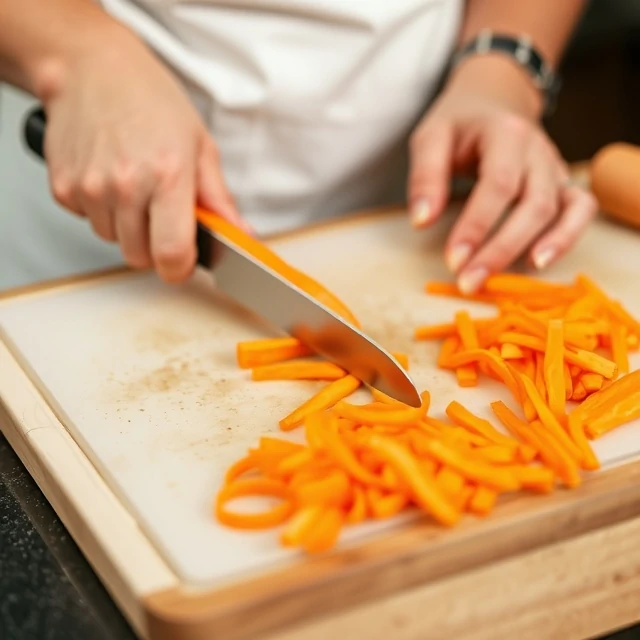
Julienning cuts vegetables into thin matchstick strips. The strips are usually 2 to 3 millimeters wide and 4 to 5 centimeters long. The cut is precise. The strips are uniform. The uniformity ensures even cooking. The shape is elegant. The julienne is a classic cut. It is used for carrots, zucchini, bell peppers, and potatoes. It is used in salads, stir-fries, and garnishes. The julienne is the cook's test. The julienne is the cook's art. The julienne is the same.
Julienning has several steps. The vegetable is first cut into planks. The planks are stacked. The planks are cut into strips. The strips are cut into lengths. The knife must be sharp. The cuts must be straight. The strips must be even. The technique is the same for all vegetables. The size is the variable. A fine julienne is 1 to 2 millimeters. A standard julienne is 2 to 3 millimeters. A batonnet is 6 millimeters. The julienne is the fine. The batonnet is the thick. The cut is the difference. The difference is the cut. The cut is the same.
Julienning is a fundamental skill. It is taught in culinary school. It is practiced in professional kitchens. It is used in home kitchens. A julienned carrot cooks quickly in a stir-fry. A julienned zucchini looks beautiful in a salad. A julienned potato becomes a crisp shoestring fry. The julienne is the shape. The shape is the function. The function is the flavor. The flavor is the meal. The meal is the julienne. The julienne is the same. The same is the kitchen. The kitchen is the julienne. The julienne is the cook. The cook is the julienne. The julienne is the same. The same is the meal. The meal is the julienne. The julienne is the same.
Comments
No comments yet. Be the first to share a thought.
Leave a comment