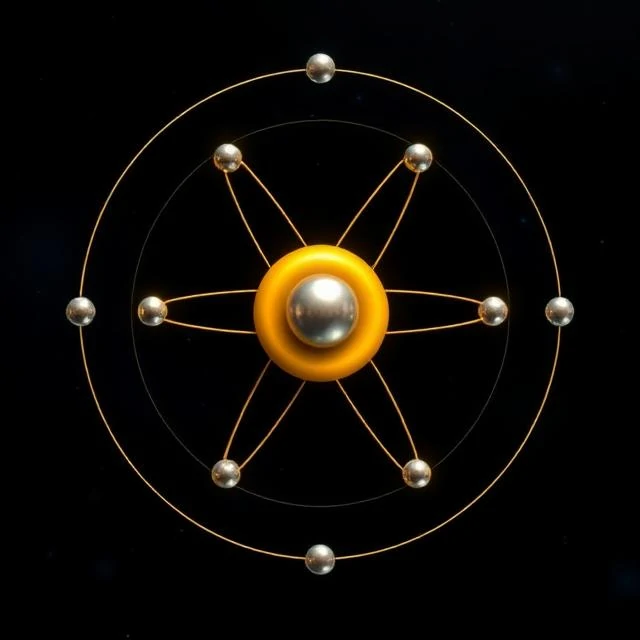
James Chadwick discovered the neutron in 1932. It is a subatomic particle with no electric charge and a mass slightly greater than a proton. It sits in the nucleus alongside protons. The number of neutrons determines the isotope of an element. Carbon-12 has six neutrons. Carbon-14 has eight. The neutron is essential for nuclear stability and nuclear reactions.
Neutrons are not stable on their own. A free neutron decays in about 15 minutes into a proton, an electron, and an antineutrino. That is beta decay. Inside a stable nucleus, neutrons are stable because the strong nuclear force binds them to protons. The balance of protons and neutrons determines whether a nucleus is stable or radioactive. Too many or too few neutrons lead to decay.
Neutrons are used in many applications. Neutron scattering reveals the structure of materials, especially those containing hydrogen. Neutron activation analysis identifies trace elements. Neutron therapy treats certain cancers. Neutron bombs are a type of nuclear weapon designed to release lethal neutron radiation. Nuclear reactors use neutrons to sustain fission chain reactions.
The neutron is a baryon, made of three quarks: one up quark and two down quarks. Its magnetic moment is nonzero, which was a surprise when it was measured. The neutron is not a fundamental particle, but it is a fundamental building block of matter.
Comments (2)
Leave a comment