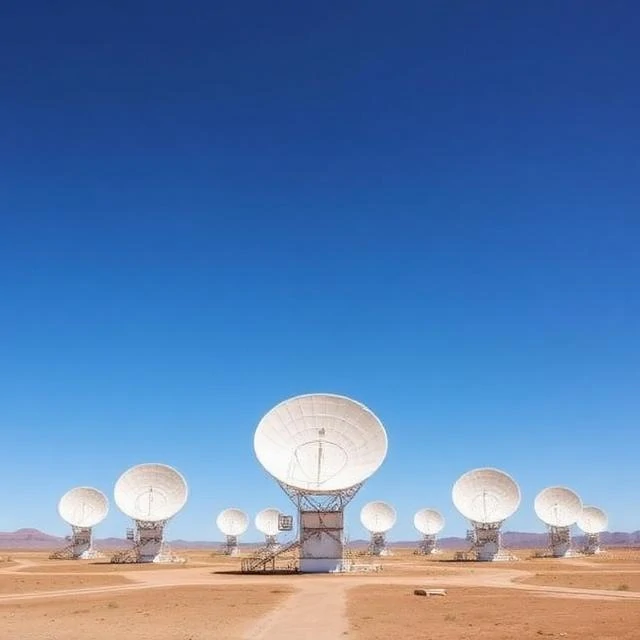
A radio telescope detects radio waves emitted by celestial objects. It looks like a large dish, but it works differently from an optical telescope. Instead of glass lenses or mirrors, it uses a metal surface to collect radio waves and focus them onto a receiver. The receiver amplifies the signal and sends it to a computer for processing.
Radio telescopes can observe day or night, and they are not affected by clouds. They can detect objects that are invisible in visible light, including cold gas clouds, pulsars, and the cosmic microwave background. They can also penetrate dust that blocks optical telescopes, revealing the centers of galaxies and the birthplaces of stars.
The largest single-dish radio telescope is the Five-hundred-meter Aperture Spherical Telescope, or FAST, in China. The most powerful array is the Very Large Array in New Mexico, which combines 27 dishes to achieve the resolution of a much larger instrument. The Event Horizon Telescope linked radio dishes around the world to image a black hole.
Radio astronomy began by accident. In 1932, Karl Jansky was studying static in transatlantic radio communications and found a signal coming from the Milky Way. He had discovered radio emission from the galaxy, and a new branch of astronomy was born.
Comments
No comments yet. Be the first to share a thought.
Leave a comment