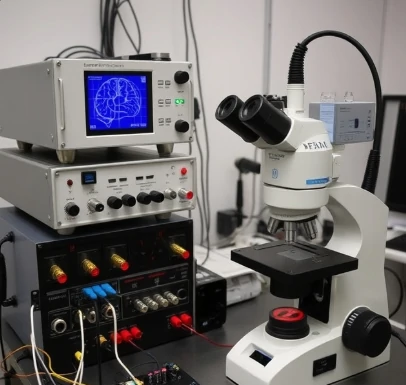
The functions of neurons and circuits are the province of neurophysiology. The field measures electrical and chemical activity, from the opening of single ion channels to the coordinated firing of large populations during behavior.
Classic tools include intracellular and extracellular recording, voltage-clamp and patch-clamp techniques, and stimulation of pathways. Newer methods add optical imaging of calcium or voltage, optogenetic control, and high-density silicon probes that record hundreds of cells simultaneously. These approaches reveal how synaptic inputs are integrated, how spikes are generated and propagated, and how networks produce oscillations and coded representations.
Neurophysiology provides the mechanistic link between anatomy and behavior. It also supplies the rational basis for understanding disease states such as epilepsy and for developing interventions that restore or modulate activity. Training in the discipline emphasizes both technical skill and rigorous interpretation of dynamic signals.
- Study of nervous-system function
- Focuses on electrical and chemical signaling
- Uses recording, imaging, and stimulation
- Links cellular mechanisms to behavior
Comments (3)
Leave a comment