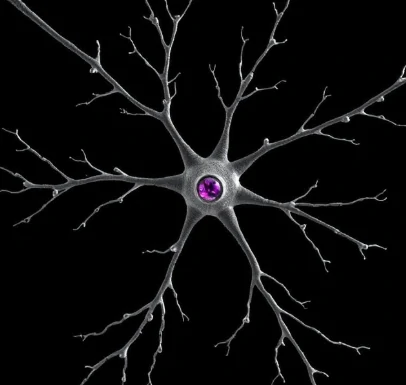
A neuron is a nerve cell specialized for transmitting electrical and chemical signals. It is the basic functional unit of the nervous system.
A typical neuron has a cell body that contains the nucleus, dendrites that receive incoming signals, and a single axon that carries outgoing signals to other cells. At rest the membrane maintains an electrical potential; when sufficiently stimulated, it generates an action potential that travels rapidly along the axon. At the axon terminals the electrical signal is converted into the release of neurotransmitter, which crosses the synaptic cleft and influences the next cell.
Neurons vary enormously in size, shape, and connection pattern. Sensory neurons bring information from receptors; motor neurons carry commands to muscles and glands; interneurons process information within the central nervous system. The human brain contains roughly eighty-six billion neurons, each forming thousands of synapses on average.
Every message that travels through the nervous system travels, at some point, along a neuron.
Comments (3)
Leave a comment