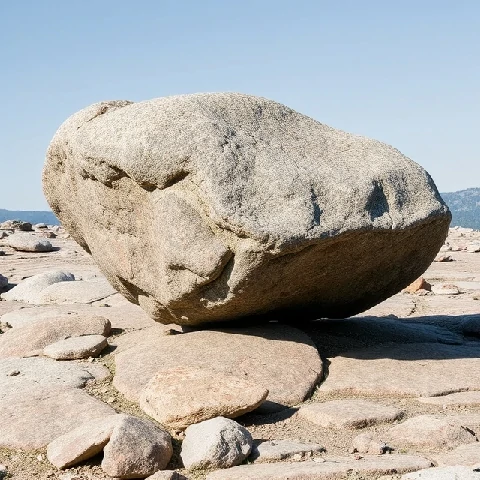
A lone boulder of foreign rock sitting on dissimilar bedrock often has a glacial explanation. An erratic is a rock fragment transported by glacial ice and deposited far from its place of origin when the ice melts. Size ranges from pebbles to house-sized blocks.
Erratics provided early evidence that ice sheets once covered regions now free of permanent ice. Matching the boulder’s lithology to a distant source outcrop reveals the direction of ice flow. Some erratics have been carried hundreds of kilometers.
They litter landscapes across former glaciated regions of North America, Europe, and elsewhere. Large erratics sometimes served as landmarks or cultural monuments. Geologists still use trains of erratics to map the paths of ancient ice streams and lobes.
- Rock transported and dropped by a glacier
- Differs from local bedrock
- Evidence of past ice-sheet extent and flow
- Can range from small clasts to massive blocks
Comments
No comments yet. Be the first to share a thought.
Leave a comment