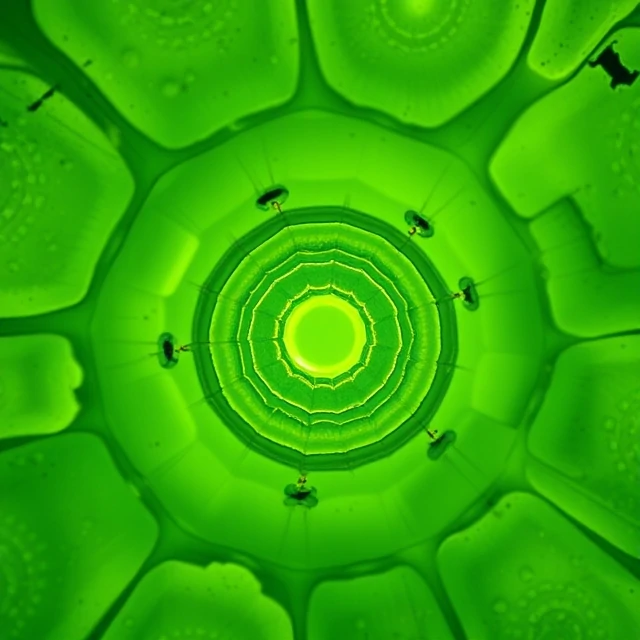
Plants make their own food. They use sunlight, water, and carbon dioxide to produce sugars and oxygen. That process is photosynthesis, and it is the foundation of most life on Earth. It happens in chloroplasts, tiny structures inside plant cells that contain the green pigment chlorophyll. Chlorophyll absorbs sunlight, mainly in the blue and red parts of the spectrum. The captured energy splits water molecules, releasing oxygen as a byproduct. The hydrogen and carbon dioxide are then used to build glucose.
Photosynthesis has two main stages. The light-dependent reactions capture energy from sunlight and produce ATP and NADPH. The Calvin cycle uses that energy to convert carbon dioxide into sugars. The overall equation is simple: six molecules of carbon dioxide plus six molecules of water produce one molecule of glucose and six molecules of oxygen. In reality, the process involves dozens of enzymes and intermediate compounds. Photosynthesis is not perfectly efficient. Plants convert only a small fraction of the sunlight they receive into chemical energy. That is why ecosystems need so much sunlight to support so much life.
Inputs and outputs
- Inputs: sunlight, water, carbon dioxide.
- Outputs: glucose, oxygen.
- Location: chloroplasts in plant cells.
- Pigment: chlorophyll, which absorbs light.
Photosynthesis and respiration are partners. Plants produce oxygen and glucose. Animals consume them and release carbon dioxide. The cycle keeps the atmosphere breathable.
Comments (3)
Leave a comment