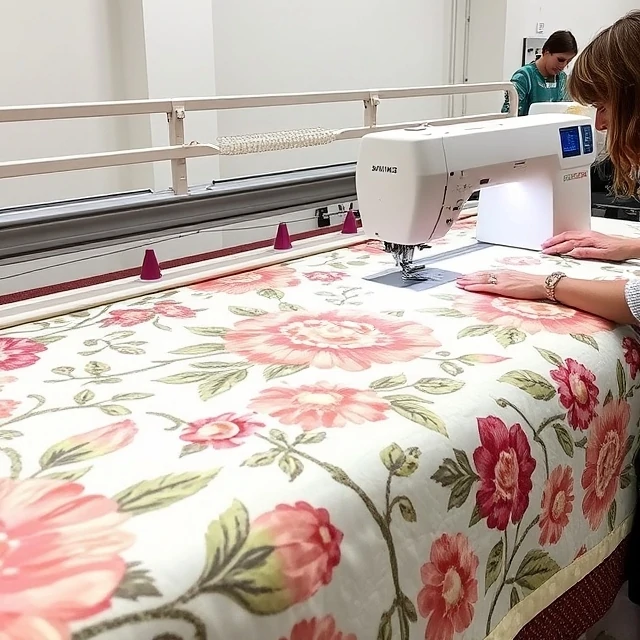
Quilting stitches layers of fabric together to make a quilt. The standard sandwich is a pieced or plain top, a layer of batting for warmth, and a backing fabric. The stitches run through all three layers and hold them in place. Without quilting, the batting shifts and bunches after a few washes.
Hand quilting uses a short needle and small, even stitches. Machine quilting uses a domestic sewing machine or a longarm quilting machine on a frame. Longarm machines let the quilter move the machine head over a stationary quilt, which is faster and gives more room for large designs. Free-motion quilting drops the feed dogs so the quilter can move the fabric in any direction, drawing loops, feathers, and spirals with thread.
Quilting styles
- In the ditch — stitching right along the seam lines
- Stitch in the ditch — same thing, common in utility quilts
- Echo quilting — lines that follow the shape of an appliqué or motif
- Free-motion — any pattern the quilter can guide by hand
The quilting itself can be the main design. A simple patchwork top with dense, intricate stitching can outshine a complicated pieced top with plain lines. Thread color matters too. Matching thread hides stitches. Contrasting thread makes them a feature.
Comments
No comments yet. Be the first to share a thought.
Leave a comment