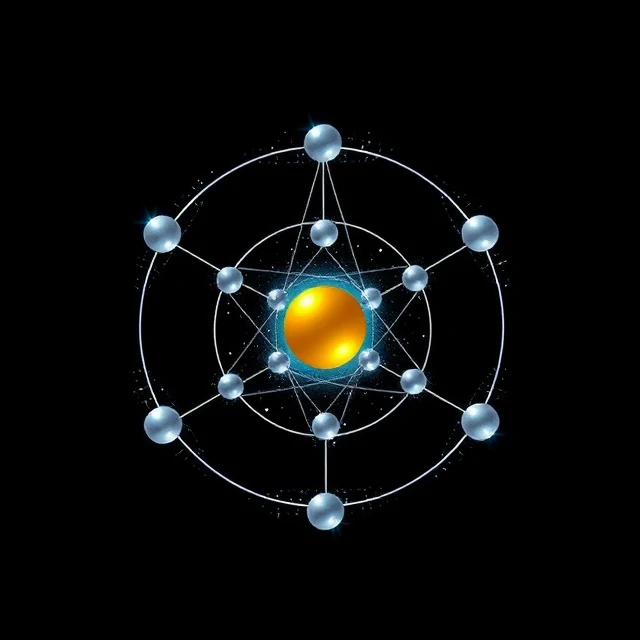
The nucleus is the central core of an atom. It contains protons and neutrons, collectively called nucleons. It is tiny, about 1/100,000th the diameter of the atom, but it contains almost all the mass. The number of protons determines the element. The number of neutrons determines the isotope. The nucleus is held together by the strong nuclear force, which overcomes the electrostatic repulsion between protons.
The nucleus was discovered by Ernest Rutherford in 1911, through the gold foil experiment. He fired alpha particles at a thin gold foil and found that some bounced back. That meant the positive charge was concentrated in a tiny volume, not spread throughout the atom. The discovery changed the model of the atom from a plum pudding to a planetary system.
The nucleus is not static. It can undergo radioactive decay, emit particles, and split in fission. It can fuse with other nuclei in fusion. These nuclear reactions release enormous amounts of energy, far more than chemical reactions. That is why nuclear power and nuclear weapons are so powerful.
The nucleus is also a quantum system. Protons and neutrons are not simple spheres. They are made of quarks, held together by gluons. The strong force is one of the four fundamental forces of nature. Understanding the nucleus is a central goal of nuclear physics.
Comments
No comments yet. Be the first to share a thought.
Leave a comment