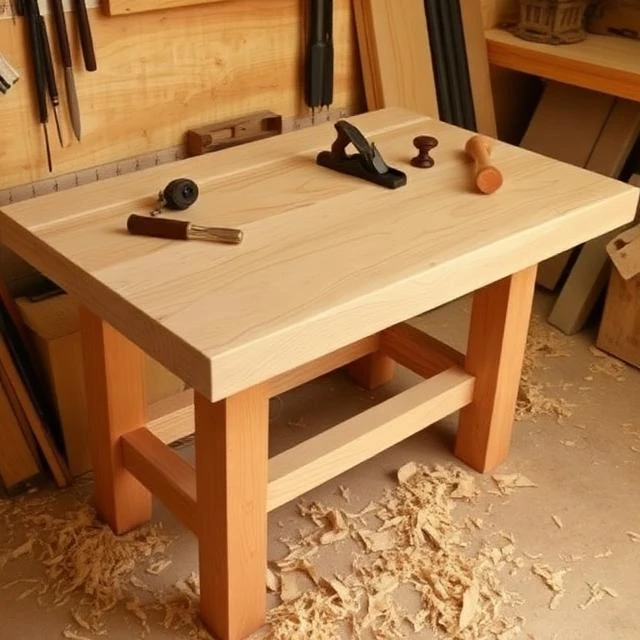
Woodworking builds objects from wood. Furniture, cabinets, boxes, frames, toys, and tools all fall under the craft. The work starts with stock preparation: milling rough lumber flat, square, and to thickness. Then comes joinery, the part that holds the piece together. Dovetails, mortise and tenon, biscuits, and pocket screws are all ways to connect two boards. Some are strong and beautiful. Some are fast and hidden. The choice depends on the project and the maker's skill.
Hand tools and power tools both have a place. A sharp hand plane leaves a surface that sandpaper cannot match. A table saw cuts repeated parts quickly and accurately. A router shapes edges and cuts grooves. A chisel cleans up the corners. Most workshops use a mix. The craft rewards planning. Measure twice, cut once is a cliché because it is true. A cut that is too short cannot be stretched. A hole in the wrong place cannot be un-drilled without a visible patch.
Core woodworking joints
- Butt joint — simple, weak, needs glue and screws
- Dado — a groove that holds a shelf or panel
- Mortise and tenon — strong, traditional, used in furniture
- Dovetail — interlocking, resists pulling apart, beautiful
- Biscuit joint — fast, aligned, good for panels and tabletops
Glue is not a gap filler. Joints must fit tight. A loose joint with glue is still a loose joint. Cut, test, adjust, and only then glue up.
Comments
No comments yet. Be the first to share a thought.
Leave a comment