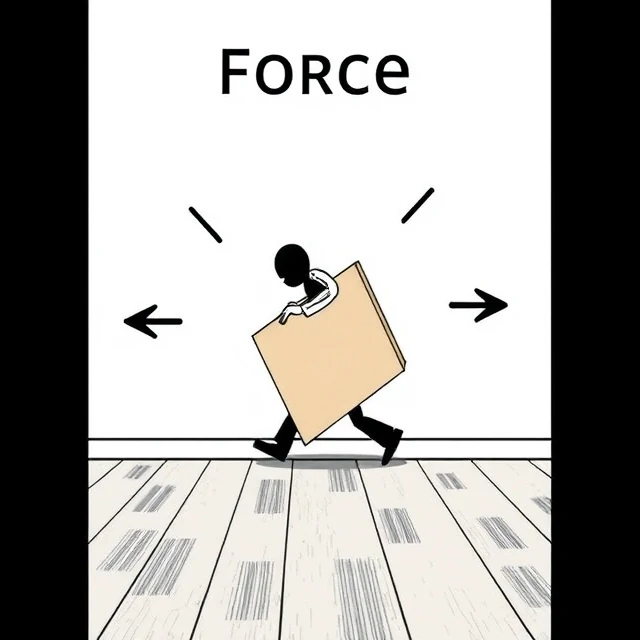
Push a door and it opens. Pull a rope and it moves. Kick a ball and it flies. A force is an interaction that changes the motion of an object. It can speed something up, slow it down, change its direction, or deform it. Force is a vector, with both magnitude and direction. It is measured in newtons. One newton is the force needed to accelerate one kilogram at one meter per second squared. That is about the weight of a small apple.
Forces come in many forms. Gravity pulls objects toward each other. Electromagnetism acts between charged particles. The strong force binds quarks into protons and neutrons. The weak force governs radioactive decay. In everyday life, we deal with friction, tension, normal force, and applied force. Newton's three laws describe how forces affect motion. The first law says an object stays at rest or in uniform motion unless a force acts on it. The second law says force equals mass times acceleration. The third law says every action has an equal and opposite reaction. Forces are always interactions between two objects. There is no such thing as a force acting on nothing.
Force facts
- Definition. Interaction that changes motion.
- Unit. Newton (N).
- Vector. Has magnitude and direction.
- Four fundamental forces. Gravity, electromagnetism, strong, weak.
- Newton's laws. Describe how forces affect motion.
Force is not the same as energy. Force is a push or pull. Energy is the capacity to do work.
Comments
No comments yet. Be the first to share a thought.
Leave a comment