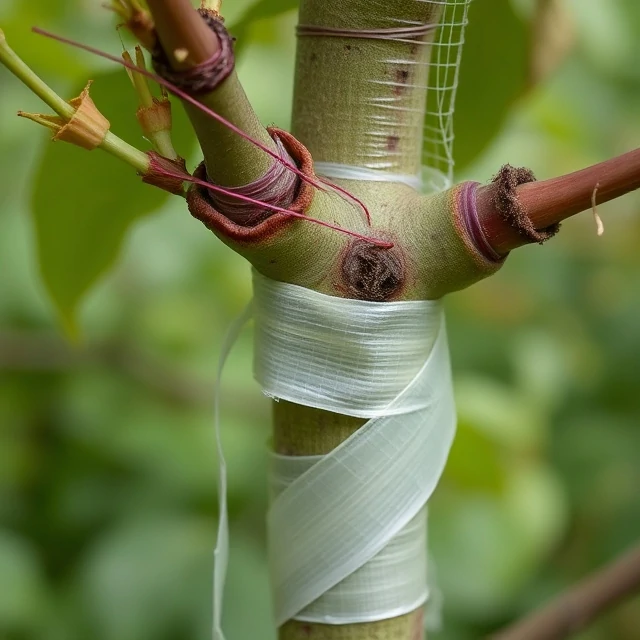
Grafting joins living tissues of two plants so they grow as one. The upper part, called the scion, provides the desired flowers, fruit, or form. The lower part, the rootstock, supplies the root system and sometimes influences vigor or disease resistance. When the cambium layers of both parts align and heal, a permanent union forms.
Common methods include whip-and-tongue, cleft, and side grafts. Timing usually coincides with active growth in spring or with dormant wood in winter, depending on the technique. Clean cuts, firm contact, and protection from drying are essential. Tape, wax, or grafting clips hold the pieces until the tissues knit.
Fruit trees, roses, and many ornamentals are routinely grafted. The technique allows gardeners to grow multiple varieties on one tree or to propagate plants that do not root easily from cuttings. Success improves with practice and sharp tools.
- Joins parts of two plants to grow as one
- Combines desired top with suitable roots
- Requires aligned cambium layers
- Used for fruit trees and ornamentals
Comments
No comments yet. Be the first to share a thought.
Leave a comment