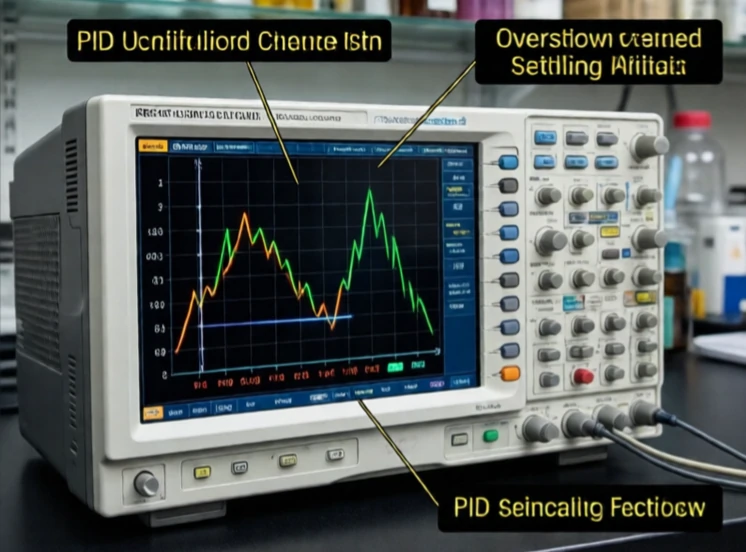
A PID controller is the most common control loop in engineering. It combines three terms: proportional, integral, and derivative. Each term responds to the error between a desired setpoint and the measured output. The sum of the three terms drives the actuator.
Proportional action responds to the current error. Integral action responds to the accumulated past error. Derivative action responds to the predicted future error. Together they provide fast response, zero steady-state error, and damping. The controller is simple to implement and works well for a wide range of systems. That is why it is in thermostats, drones, cruise control, and industrial processes.
PID tuning parameters
- Kp: proportional gain, responds to current error.
- Ki: integral gain, eliminates steady-state error.
- Kd: derivative gain, reduces overshoot.
- Sample time: how often the loop runs.
- Anti-windup: prevents integral term from growing too large.
Tuning is the hard part. Ziegler-Nichols rules give a starting point. Manual tuning refines it. Too much Kp and the system oscillates. Too much Ki and it overshoots. Too much Kd and it amplifies noise. The goal is a response that reaches the setpoint quickly, with minimal overshoot, and stays there. Some systems auto-tune by injecting a step input and measuring the response. Others use model-based tuning. A well-tuned PID controller is invisible. The system just works. A poorly tuned one oscillates, overshoots, or responds sluggishly. PID is not always the best controller, but it is almost always the first one tried.
Comments
No comments yet. Be the first to share a thought.
Leave a comment