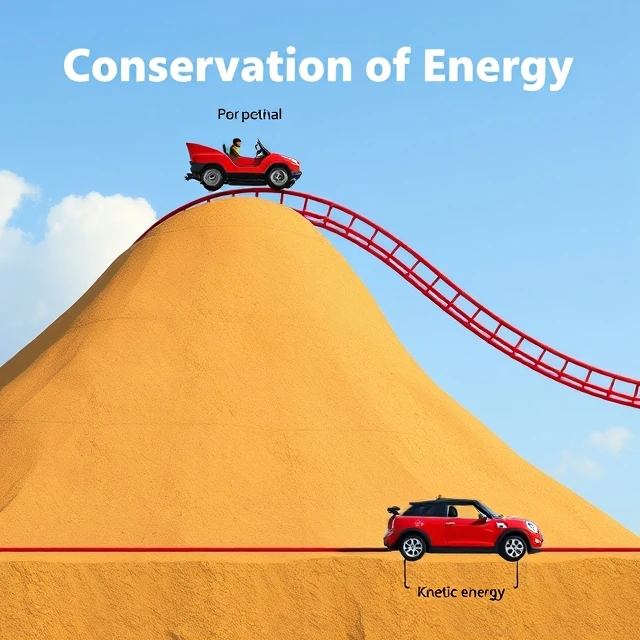
Energy cannot be created or destroyed. It can only change form. That principle, the conservation of energy, is one of the most fundamental laws of physics. A roller coaster car at the top of a hill has potential energy. As it drops, that energy becomes kinetic energy. At the bottom, the car is moving fast. As it climbs the next hill, kinetic energy becomes potential energy again. The total amount of energy stays the same throughout, minus a little lost to friction and air resistance.
The law applies to every system, from a swinging pendulum to a nuclear reaction. In a closed system, the total energy is constant. In an open system, energy can enter or leave, but it is never created or destroyed. The first law of thermodynamics is a statement of energy conservation. It says that the change in a system's internal energy equals the heat added minus the work done by the system. Energy conservation is not just a bookkeeping rule. It is a constraint that shapes what is possible. A perpetual motion machine, which would create energy from nothing, is impossible for this reason.
Forms of energy
- Kinetic. Energy of motion.
- Potential. Stored energy due to position or state.
- Thermal. Energy of random particle motion.
- Chemical. Energy stored in bonds.
- Nuclear. Energy stored in atomic nuclei.
Energy is conserved, but it often becomes less useful. That is the subject of the second law of thermodynamics, which introduces entropy.
Comments
No comments yet. Be the first to share a thought.
Leave a comment