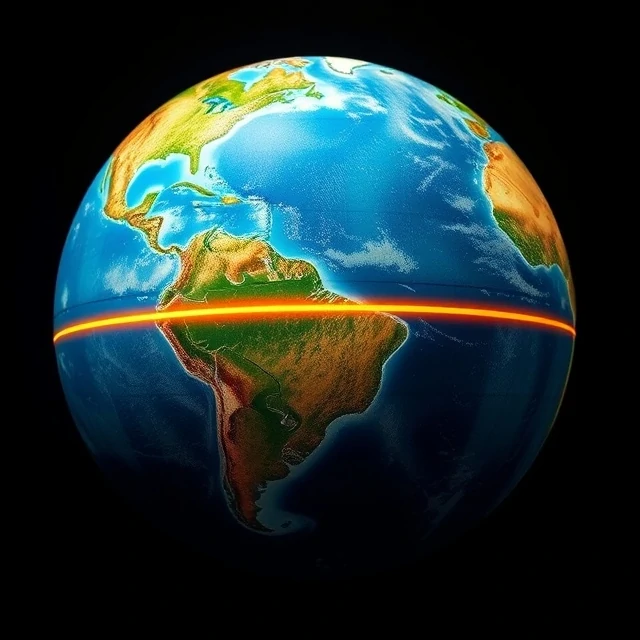
Halfway between the North and South Poles lies an imaginary line that divides the planet into Northern and Southern Hemispheres. The equator is the great circle where latitude is defined as zero. It spans roughly 40,075 kilometers.
Locations on the equator experience nearly equal day and night throughout the year. The sun passes directly overhead at the March and September equinoxes. Tropical climates dominate, though elevation and ocean currents create local variation.
The equator crosses South America, Africa, and Southeast Asia as well as the Atlantic, Pacific, and Indian Oceans. It serves as the reference for the geographic coordinate system and for climate models. Standing on the equator, a traveler is as far from either pole as it is possible to be on Earth’s surface.
- Zero-degree line of latitude
- Divides Northern and Southern Hemispheres
- Experiences consistent day length
- Reference for geographic coordinates
Comments
No comments yet. Be the first to share a thought.
Leave a comment