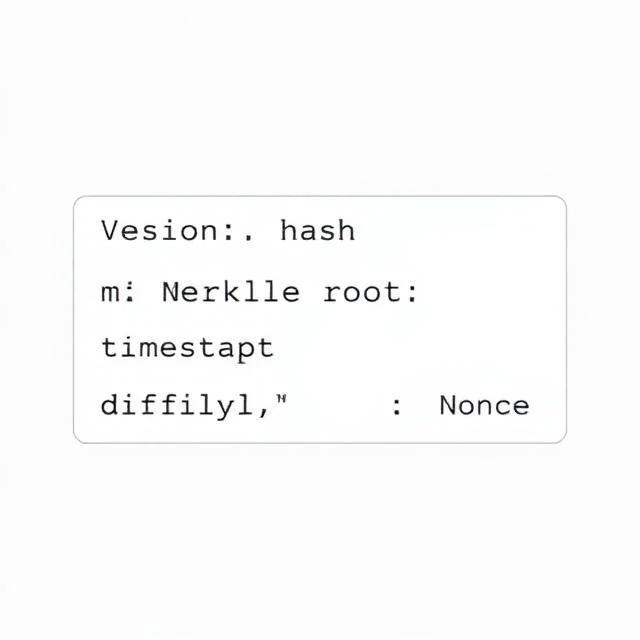
A nonce is a number used once. In mining, it is the variable that miners change when hashing a block header. The header contains the previous block's hash, a timestamp, the Merkle root, the difficulty target, and the nonce. Miners try different nonce values until the resulting hash falls below the target. There is no shortcut. The only way to find a valid nonce is to guess and check, billions of times per second. The first miner to find it gets to broadcast the block.
The nonce field in Bitcoin is 32 bits, which allows about 4 billion possible values. That sounds like a lot, but modern ASICs exhaust the nonce space quickly. When that happens, miners change other parts of the block header, like the timestamp or the coinbase transaction, and start over. That gives them a fresh set of nonces to try. The nonce is a small number with a big job. It makes proof-of-work possible and prevents miners from reusing the same hash. Without it, finding a valid block would be impossible to randomize.
Nonce facts
- 32-bit field in Bitcoin — about 4 billion possible values
- Changed by miners to find a valid hash
- Exhausted quickly — miners adjust other header fields
- Not secret — the winning nonce is published in the block
The nonce is not a security feature. It is a mechanism for making the hash unpredictable and the work verifiable.
Comments
No comments yet. Be the first to share a thought.
Leave a comment