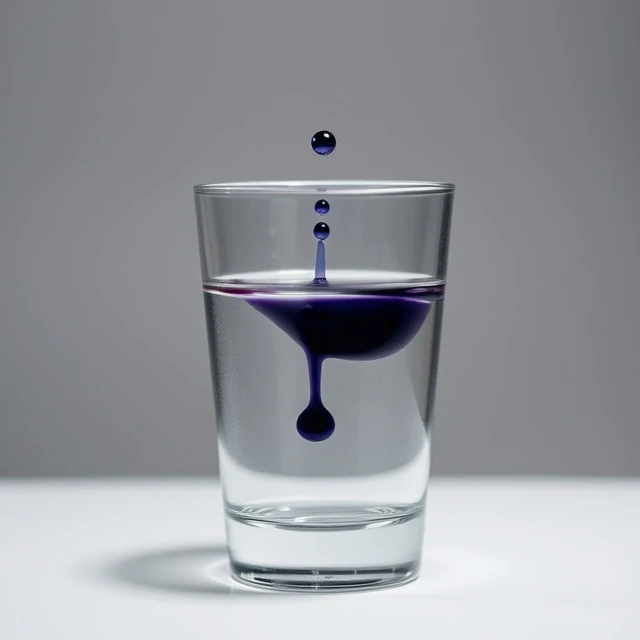
A drop of ink in water spreads out until it is evenly distributed. It never spontaneously re-concentrates. That is entropy, a measure of the disorder or randomness of a system. The second law of thermodynamics states that the total entropy of an isolated system always increases over time. Energy disperses. Order gives way to disorder. The universe moves toward equilibrium.
Entropy is a thermodynamic state function, usually denoted by S. It is measured in joules per kelvin. The change in entropy, delta S, is positive when disorder increases. Melting ice increases entropy because liquid water is more disordered than solid ice. Dissolving a salt increases entropy because the ions are more dispersed. A chemical reaction that produces more gas molecules than it consumes usually increases entropy.
Entropy is not just about disorder. It is about the number of ways a system can arrange its energy. A system with more accessible microstates has higher entropy. The Boltzmann equation, S = k ln W, relates entropy to the number of microstates, W. A perfectly ordered crystal at absolute zero has only one microstate, so its entropy is zero. That is the third law of thermodynamics.
Entropy determines the direction of spontaneous change. A reaction is spontaneous if the change in Gibbs free energy, delta G = delta H - T delta S, is negative. A reaction with positive enthalpy can still be spontaneous if the entropy increase is large enough. Entropy is the reason some endothermic reactions occur.
Comments
No comments yet. Be the first to share a thought.
Leave a comment